A market-making firm in Chicago runs statistical-learning models that revise their view of the order book several hundred times a second, on hardware that sits in the same building as the exchange. A landing page you scrolled past last week sells an "AI trading bot" for $89 a month. Both get described as artificial intelligence.
Only one of them is. This page is about the distance between those two sentences, because that distance is where a lot of retail money dies.
Four words that get used as one
Most arguments about AI in trading are really arguments about vocabulary. Four different things get called one thing, and once you can tell them apart, half the sales pages on the internet stop working on you.
| Term | What it actually is | Who writes the logic | The characteristic failure |
|---|---|---|---|
| Automation | A computer executing a decision a person already made | A person, in advance | The plan was bad and the machine follows it anyway, perfectly |
| Algorithm | A fixed procedure: these inputs, these steps, this output | A person, in advance | Same. An algorithm is the plan written precisely enough to run |
| Machine learning | Rules fitted to historical data by an optimizer rather than written | An optimizer, from examples | It fits the noise, breaks when the data changes, and nobody can say why |
| Large language model | Trained to predict the next chunk of text, prompted in plain English | Trained from text, steered by whoever is typing | No prices, no positions, and it invents facts in a calm voice |
The first two are not artificial intelligence in any useful sense. They are arithmetic that runs on schedule. Nearly every product sold as a "trading bot" (including Rentabilio, sold on this site) lives in those first two rows. We say so on the box rather than in a footnote, and the rest of this page is why that is a feature.
AI is a category of tool, not a category of edge. The useful question is never "does it use AI." It is "what decides, on what data, and can I reproduce the result myself." A system that cannot answer those three is not sophisticated. It is unverifiable, which is a different word.
Where machine learning really earns its keep
Institutions spend serious money on machine learning and get serious value back. It is worth knowing where, because the list is nothing like what the ads suggest.
Notice what is not on that list. None of the four is "tell me where the S&P closes tomorrow." They are jobs where the target holds still, feedback is fast, the sample is large, and being slightly wrong costs a basis point instead of the account. Machine learning is very good at problems shaped like that. Price direction is shaped like the opposite.
Why price direction is the hardest job on the list
Forecasting price is where machine learning struggles most, and not because nobody smart has tried. Because everybody smart has tried, continuously, for decades, with better data than you have.
Three properties make it uniquely nasty. It is adversarial: every other participant is trying to take the same money, and any pattern that becomes widely known gets traded away by the people who found it. It is non-stationary: the relationship you fitted last year is not guaranteed to hold this year, which breaks the core assumption underneath most statistical learning. And the signal is tiny next to the noise, so a model has to pick out a whisper during a hurricane from a sample much smaller than it looks.
Prediction does happen, to be clear. High-frequency market makers genuinely forecast the next few hundred milliseconds of order book behavior and make money doing it. But look at what that takes: colocated servers, custom hardware, exchange feeds priced in the tens of thousands a month, and teams whose full-time job is the model. The horizon is milliseconds, the edge per trade is a fraction of a tick, and it only pays because it repeats millions of times. None of that transfers to an $89 download that trades once a day.
If a retail vendor had solved directional prediction, selling you a subscription would be the worst possible use of it.
The market changes the answer key
Non-stationarity deserves its own section because most people skip it. A model learns a mapping from inputs to outputs by looking at examples, and that works when the mapping holds still. Handwriting does not change its mind about what the letter "a" looks like. Markets do exactly that, without telling you.
Think about the last two decades. Zero rates, then rates at five percent. A decade of index funds absorbing flow, then a volatility complex that unwound in a single afternoon in February 2018. March 2020 rewrote every correlation on the desk in nine trading days. None of those is a bad patch for a fitted model. Each is a different problem with the same variable names. The model does not know it has been handed a new exam. It answers the old one confidently.
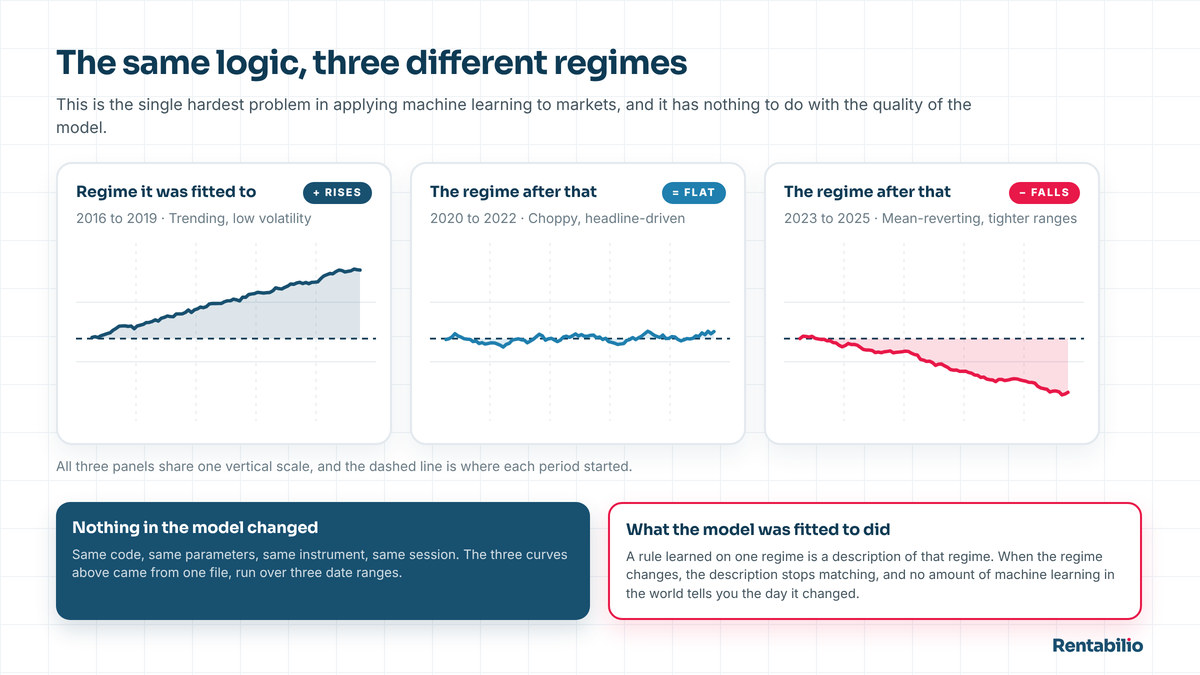
This is also why a beautiful backtest of a machine-learned strategy tells you less than a plain one. The more flexible the model, the more of the past it can bend itself around, and the harder it is to tell fitting from learning. That failure mode has a name and a whole article: overfitting and curve fitting.
Signal, noise, and how few examples you really have
Here is the arithmetic nobody puts on a sales page. Modern machine-learning models train on enormous numbers of independent examples: millions at minimum, often billions. Now count what a daily futures strategy actually has.
The full Rentabilio backtest covers more than seven years, 88 months, day by day. It produces 4,557 trades. Every one is a data point, and 4,557 is the entire labeled dataset, not per year but in total, across seven years of market history. A model with a few thousand parameters looking at a few thousand examples is not learning a market. It is memorizing one.
A model with more parameters than you have trades has not learned anything. It has remembered.
Vendors get around this by counting bars or ticks instead of trades. "Trained on 14 million data points" sounds enormous until you notice consecutive bars are nearly identical to each other, and that what you needed was independent outcomes. The counting problem is laid out in machine learning in trading.
What "AI-powered" usually means on a sales page
"AI-powered" is a marketing phrase with no definition and no enforcement behind it. Nobody has to prove anything to print it. So it is worth having a translation table.
| The claim | What it usually is | The question that settles it |
|---|---|---|
| "AI-powered signals" | Indicator crossovers, or a scoring formula a person tuned by hand | What are the inputs, and what does the output number mean? |
| "Self-learning, adapts to the market" | Parameters re-optimized on recent data every so often | When did it last change its parameters, and what did the curve do before and after? |
| "Neural network technology" | Occasionally true; usually a small net fitted to a few years of bars | How many parameters, how many trades in training, what walk-forward result? |
| "Trained on millions of data points" | Bars or ticks counted as if they were independent examples | How many closed trades, over what dates, out of sample? |
| "94% accuracy" | Accuracy in-sample, or on a label that is trivially easy to get right | Never mind accuracy. Profit factor and max drawdown? |
| "Used by hedge funds" | Nothing. It is a sentence | Which ones? There is never an answer. |
Not every vendor using the phrase is dishonest; some genuinely fitted a model. It means the phrase carries no information, so you have to get your information somewhere else: from a report you can regenerate yourself. The full list of tells is in how to spot a trading bot scam in five minutes, and the short version of this argument is in AI trading: what is real.
Every number we publish comes from a backtest you can rerun in your own NinjaTrader 8: the same period, the same instrument, the same settings. Including the losing months.
The black box problem
Suppose a vendor really did train a model and it really works. There is still a cost you inherit, and it arrives on the worst possible day.
When a rule-based system has four losing days, you open it and look. The rule said enter above the level; the market opened above the level and reversed four times; that is known behavior for this system in this kind of week, and here it is in the backtest in 2019 and 2022. You still lost money, but you know what happened and whether it is normal.
When a fitted model has four losing days, the honest answer is "the input distribution may have shifted." That is not a diagnosis, it is a shrug in technical clothing. You cannot tell whether the model is inside its normal range of pain or has quietly stopped working. Those two demand opposite responses: leave it alone, or shut it off today.
It gets sharper on funded capital, where a daily loss limit and a trailing drawdown can end the account without asking your opinion. A system you cannot reason about is a system you cannot make that call on. Interpretability is not an academic nicety here. It is what tells you whether to press the button.
What a real machine-learning operation costs
The resources are the argument, so be concrete about them.
- Data. Not free end-of-day bars. Clean tick and order book history with contract rolls handled properly, which is a paid product with a serious price tag.
- Infrastructure. Machines to train on, a pipeline that replays history as it arrived rather than as it was later revised, and a way to catch the day someone leaks future information into a feature.
- People. Not a person, a team, permanently. The model needs monitoring and retraining, and whoever built it has to still be there when it drifts.
- Time. A research budget that survives eighteen months of finding nothing, which is the normal outcome.
Now ask what business model recovers that. Not an $89 subscription with a Discord. Anyone who genuinely built the thing runs it on their own money or somebody's fund, because that is worth far more than selling copies to strangers.
The case for boring rules you can read
Everything above argues for the least exciting option on the menu: a fixed set of conditions, written by people, that you can read in an afternoon.
That is Rentabilio. It trades US index futures in one window a day, at 8:30 AM ET, when American economic data hits and the pre-open starts moving with intent. It reads order flow and session bias to judge whether the setup is clean enough, and on plenty of days it decides no. When it enters, it places the stop and the target in the market in the same instant, target at 2× the risk. It never holds overnight. The mechanism is on how it works; the reasoning behind that hour is in the 8:30 AM ET window.
The backtest runs 88 months day by day on a $50,000 funded account: $274,406 gross, roughly $260,700 net after commissions of about 5%, near $1 per micro contract. In the simulation that averages about $35,500 a year, near $2,900 a month. It won 46.2% of 4,557 trades (it loses more often than it wins), with an average winner of $354 against an average loser of $193, a profit factor of 1.58 and a max drawdown of $4,379.
Those are simulated figures, and the point of publishing them in this much detail is not that they are impressive. It is that you can regenerate them: load the strategy into the NinjaTrader 8 Strategy Analyzer, set the same dates, press Run, check. You cannot do that with a model whose weights are a trade secret. If backtests are new to you, start with what a backtest is.
Hypothetical performance. The figures above come from a backtest, not from a live account. Simulated results are prepared with the benefit of hindsight, carry no financial risk, and cannot fully account for real execution, slippage or liquidity. Past performance, real or simulated, does not guarantee future results.
Five questions for anyone who says AI
You do not need to understand gradient descent to run this test. Five questions and the patience to wait for real answers.
- What exactly makes the decision? A rule someone wrote, or parameters an optimizer found? Both are legitimate. Refusing to say is not.
- How many closed trades are in the record, over what dates? Trades. Not bars, not ticks, not "data points."
- Which period was held out? If the model saw all of it while fitting, the report describes the past rather than testing anything.
- Can I reproduce it on my own machine? With a standard tool, from the same inputs. If the answer is a screenshot, you have your answer.
- How would I tell a bad stretch from a broken system? Anyone running something real has a specific reply. Anyone who is not will change the subject.
Those five work on us as well as on anyone else, which is the point. More on choosing between systems in best trading bots, and on the machinery underneath in algorithmic trading. For the practical side (using AI tools day to day without pretending they forecast), see how to trade with AI.
Frequently asked questions
Does AI actually work in trading?
Yes, in specific places. Machine learning does real, profitable work in execution, regime classification, alternative-data parsing and risk, and high-frequency market makers genuinely predict order book behavior over milliseconds. What nobody has solved is reliable prediction of price direction over the horizons a retail trader cares about. Two very different claims, same two letters.
Is Rentabilio an AI system?
No, and we will not describe it as one. Rentabilio is a rule-based automated system: conditions written by people, executed at 8:30 AM ET, with the stop and target placed in the market at entry. Nothing in it fits itself to recent data or changes its own behavior. That is exactly why the backtest can be reproduced by anybody with NinjaTrader 8 and the same historical data.
Can ChatGPT predict the stock market?
No. A language model predicts the next chunk of text, has no live price feed unless a tool gives it one, and has a training cutoff. Ask it the current level of an index and it will usually produce a plausible number it invented, in the same tone it uses for correct answers. Useful for explanation, code and note-taking; terrible as a source of prices or signals. The line is drawn in ChatGPT for trading.
Why would a working AI system be sold to the public at all?
That is the question worth sitting with. A strategy with a durable edge is worth more run on capital than sold as copies, and every extra user degrades it by competing for the same fills. Selling software is a legitimate business, but it means the product is tooling and discipline, not a secret nobody else has. Ask any vendor implying otherwise why they picked the less profitable option.
What is the difference between algorithmic trading and AI trading?
Algorithmic trading means a defined procedure decides and executes, with the logic written by a person in advance. AI trading, used precisely, means part of that logic was learned from data by an optimizer instead. Almost everything sold to retail traders is the first thing labeled as the second. The first is auditable and the second is not, which matters more than the label does.
Is a black box model automatically a bad idea?
Not automatically, but it changes what you are buying. With an opaque model you cannot separate a normal losing stretch from one that has quietly stopped working, and those require opposite responses. On a funded account with a daily loss limit, that ambiguity is expensive. Accept a black box knowingly, and size it as though you may have to switch it off without ever understanding why.