A tick on the Micro E-mini S&P 500 is worth about $1.25. The contract clears through the CME. Tick size, trading hours and expiration dates are published by the exchange and identical for everyone holding one. And at 8:30 AM ET, when the month's payrolls or inflation number hits the wire, that market is already open and deep enough to absorb the reaction.
Those four facts are most of the argument for automating futures rather than anything else. A program needs a world with fixed rules, and US index futures are the closest thing retail trading has to one.
Why futures are the sanest market to automate
Automation is not a technology problem. It is a measurement problem. You are trying to prove a set of rules had an edge over years of history, and that proof collapses the moment the thing you tested stops being the thing you trade.
Which is what goes wrong everywhere else. Equities split, get renamed and get delisted, so a ten-year history is quietly full of holes. Crypto has no central book, so "the price" depends on which exchange you looked at. Retail forex and CFDs trade against a dealer whose spread widens precisely when your system wants to act. A CME index future does none of that: the MES you test against 2019 has the same multiplier, tick grid and session structure as the one you trade this morning.
Futures are easy to automate because the instrument is a published specification, not a product a company can quietly change. That gets you a trustworthy test. It does not get you a profitable system, and it does not protect you from leverage.
What actually makes futures different
Six differences matter to a machine, and they compound.
- Central clearing. The CME's clearing house sits between you and whoever took the other side, marking every account to market daily. You never have to care who your counterparty is.
- Standardization. Every MES contract is identical, so orders concentrate in one book instead of fragmenting across venues. One book means one price, tight spreads, and fills that behave the way a test assumed.
- Defined hours. Roughly Sunday evening to Friday afternoon with a short daily break. A bot can be told exactly when to be awake, and there is a real open, close and settlement to anchor rules to.
- Real depth. The E-mini and Micro E-mini S&P complex is among the most heavily traded instruments on earth, so a retail-sized order does not move it and slippage assumptions stay honest.
- No pattern day trader rule. The PDT rule caps stock day traders under $25,000 at three round trips in five business days. It does not touch futures.
- Symmetrical shorting. No borrow, no locate, no uptick rule, no extra fee, so a system takes whatever direction the data hands it.
The seventh difference let normal people in: micro contracts, which cut the E-minis to a tenth in 2019 and turned a $500 stop into a $50 one. More in futures and micro contracts.
The contracts a retail system actually trades
In practice an automated retail system in US index futures trades one of four symbols. Energy, metals, grains and currencies have different volatility and news drivers, and a system built for one is not valid on another until it is tested there.
| Contract | Symbol | Tick size | Tick value | Per index point | Notional, roughly |
|---|---|---|---|---|---|
| Micro E-mini S&P 500 | MES | 0.25 points | ≈ $1.25 | $5 | ≈ $29,500 at 5,900 |
| Micro E-mini Nasdaq-100 | MNQ | 0.25 points | ≈ $0.50 | $2 | ≈ $42,000 at 21,000 |
| Micro E-mini Dow | MYM | 1 point | ≈ $0.50 | $0.50 | ≈ $22,000 at 44,000 |
| Micro E-mini Russell 2000 | M2K | 0.10 points | ≈ $0.50 | $5 | ≈ $11,500 at 2,300 |
Tick values are set by the CME and can be changed by the CME. The notional column moves daily and is there to make one point: a single micro still represents tens of thousands of dollars of index. The contract is small. The exposure is not.
Notice too that MNQ, MYM and M2K all move about $0.50 per tick while their tick sizes differ by a factor of ten, so "a 40-tick stop" is a different amount of market movement on each.
Margin, leverage, and the part that hurts people
Margin in futures is not a loan. Nobody lends you anything and no interest accrues; it is a good-faith deposit held against the position while it is open. Because it is not a loan, it is also not a measure of risk. Confusing those two is how most futures accounts die.
| Number | Who sets it | Roughly, on one MES | What it actually tells you |
|---|---|---|---|
| Day-trade margin | Your broker | Often $50 to $150, intraday only | How many contracts the broker lets you hold. Nothing about risk. |
| Initial margin | The exchange (CME) | A few hundred dollars, revised with volatility | What you post to open a position and carry it past the close. |
| Maintenance margin | The exchange | Slightly below initial | The level the account must stay above, or you face forced liquidation. |
| Notional exposure | Contract spec × price | ≈ $29,500 | The index actually moving for you or against you. |
| Effective leverage | Arithmetic | ≈ 590× against $50 of day-trade margin | How fast a small move becomes a large share of the deposit. |
| Risk per trade | You | The stop: 40 ticks = $50 | The only number here you control. |
Read the last two rows together. At $50 of intraday margin one MES gives you roughly 590 to 1 leverage on paper, and a 1% move in the S&P is $295 on that contract, six times the deposit. The margin requirement is the broker's risk control, not yours. Yours is the stop, and it only exists if it is a live order sitting on the exchange.
Low margin does not make a position small. It makes a large position feel affordable.
So position size comes from the stop distance and the account, never from how many contracts the platform allows. The risk page works through what that means in practice.
Contracts expire, and your bot has to know it
This is the futures-specific problem with no equivalent in stocks, and it breaks more automated systems than any strategy flaw.
Index futures expire quarterly: March, June, September and December, on the third Friday. Volume does not wait for expiration day. It migrates to the next contract about a week early, and once it has moved the old contract becomes a thin, wide, badly behaved book. A bot still pointed at it keeps placing orders into a market that no longer meaningfully exists, and the fills look nothing like the backtest.
Three ways a system handles this, and you should know which one you are buying:
- Continuous contract with automatic rollover. The platform serves a stitched series and switches contracts on a defined rule, either a volume trigger or a fixed number of days before expiry. NinjaTrader 8 does this, and most retail systems rely on it.
- Manual roll. You change the symbol yourself on roll week. It works, and it fails the first time you are on vacation.
- No handling at all. The strategy hard-codes a symbol. That is a defect, not a design choice.
Rollover also contaminates backtests, because stitching two contracts that trade at slightly different prices creates an artificial gap at the seam. Ask which data convention a published test used, adjusted or unadjusted.
The stack: platform, data, broker
A futures bot needs three separate things, which people assume are one thing because they often come from the same company.
NinjaTrader 8 dominates not because it is elegant but because the Strategy Analyzer lets anyone load a strategy, set a date range, hit Run and check the numbers on their own machine before spending a dollar. The details are in NinjaTrader 8 explained. Budget for two costs people forget: exchange data fees, charged per exchange per month, and commissions of roughly $1 per micro round turn, trivial until you multiply by trade count.
The bracket order, and why it decides everything
If you take one design principle from this page, take this one. A bracket order is three orders sent as a unit: the entry, a protective stop below it, and a profit target above it, reversed for a short. Stop and target are linked, so when one fills the other cancels. That pairing is called OCO, one cancels the other. Both are live orders resting on the exchange's servers, not intentions held in your software.
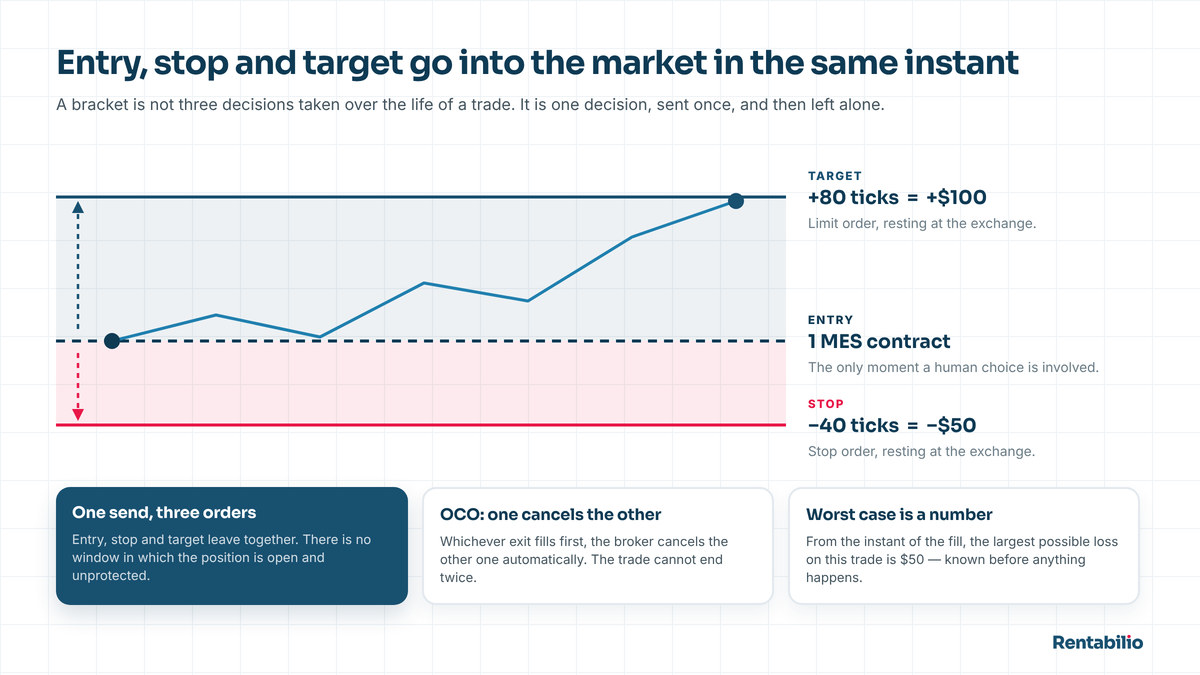
Why this is the single most important decision in an automated futures system: it moves the risk decision to the only moment you are objective. When the order goes in you have no position, no unrealized loss and no story about where price "has to" go. Thirty seconds later, holding a loser, you are a different person. Placing the stop with the entry never lets that second person decide anything.
It also survives failure. If the power goes out mid-trade the bot stops watching, but the stop and target are already at the exchange and stay live. A mental stop evaporates the instant the software does.
That is how Rentabilio is built: stop and target placed in the market at the same instant as the entry, target at 2× the risk, position closed by one or the other before the day ends, and no overnight positions ever. The full sequence is in how it works.
More than seven years of history, day by day, on micro index futures: 4,557 trades, a 46.2% win rate, a 1.58 profit factor and a $4,379 maximum drawdown, all from a simulation over historical data.
Choosing when the bot is awake
Futures trade nearly 23 hours a day. That is a feature and a trap: a bot allowed to trade all of them will find "opportunities" in the thin stretch between 1:00 AM and 6:00 AM ET, and pay full commissions for every one.
Session structure is not decoration. Overnight, US index futures mostly react to Asia and Europe on modest volume. The character of the market changes twice each morning: at 8:30 AM ET, when the major US releases land, and again at 9:30 AM ET when the cash market opens and real volume arrives.
A single defined window buys sample quality, because every trade comes from the same conditions and the test measures one repeatable situation instead of averaging five. It also buys fewer trades, fewer commissions, and a morning you can plan around.
Rentabilio trades one window a day, at 8:30 AM ET, and is flat the rest of the time. The reasoning is in why 8:30 AM ET is the moment the market shows its hand. Whether one window suits you is a question of schedule and temperament, and a main axis in the guide to choosing between trading systems.
The funded-account route that only exists in futures
Here is the structural fact with no real equivalent in stocks or crypto. In US futures an entire industry of proprietary trading firms will let you trade their capital if you pass an evaluation, and take a share of what you make.
The shape is consistent. You buy the evaluation from the firm yourself and trade under a rulebook: a profit target, a maximum loss floor, usually a trailing drawdown, often a daily loss limit and a consistency rule. The fee runs roughly $100 for a 50k account, $250 for a 100k and $400 for a 250k. Clear it and the firm funds an account whose losses are theirs, not yours. Break a rule and the account closes immediately.
For a bot owner that changes the arithmetic: the capital at risk in any attempt is the evaluation fee, not a trading account. It also adds a failure mode with nothing to do with trading: an account can be profitable and dead on the same afternoon because of a rule nobody read. Sizing is tiered: 50k runs one contract, 100k up to two, 250k up to five. We support Apex Trader Funding, Lucid Trading, My Funded Futures and Tradeify, meaning the system is built to run inside their rules. You buy the evaluation yourself and pay the firm directly.
Mechanics on funded capital, the rulebook in every funded account rule explained, the strategy side in prop firm trading.
What still goes wrong
None of this makes a futures bot safe. It makes it measurable. The failures that actually happen:
- The owner switches it off in the valley. Three red days, the finger goes to the switch, and the system is offline for the recovery. You turn a system off when it stops behaving like its own history, not when it hurts.
- Size, not strategy. Running five contracts because the account allows it multiplies the drawdown identically, and your tolerance for pain does not scale with your balance.
- A backtest fitted to the past. Enough parameters and any history can be made profitable. The mechanism is in overfitting and curve fitting.
- Infrastructure. A laptop that sleeps, an update that reboots the machine at 8:25, the roll nobody watched, a rule violation on a green day. A small VPS and a checklist solve most of it.
Hypothetical performance. The Rentabilio figures on this page come from a backtest, not from a live account: $274,406 gross, about $260,700 net after commissions, 4,557 trades and a $4,379 maximum drawdown, over more than seven years (88 months) on a $50,000 funded account. Simulated results are prepared with hindsight, carry no financial risk, and cannot fully reflect real execution or slippage. Past performance, real or simulated, does not guarantee future results.
How to check a futures bot before you pay
Everything specific to futures gives you a checklist a general "trading bot" review cannot. Ask for these six things before money moves.
- Which symbol, and was it tested there? A system validated on MES is not validated on MNQ.
- What window does it trade, and why that one? "All session" needs a reason beyond "more opportunities".
- Are the stop and target real orders placed at entry? If the answer involves the word "mental", stop there.
- How does it roll, and was the backtest run on adjusted or unadjusted data?
- Were commissions and slippage deducted? A gross-only equity curve is not a result.
- Can you reproduce the test yourself on a free NinjaTrader 8 install, same dates, same numbers? The only question that cannot be faked.
A seller who cannot answer all six is usually not hiding something. They have not done the work. The longer version of that filter is in how to spot a trading bot scam; the setup path is on get started.
Frequently asked questions
How much money do I need to run a futures trading bot?
There are two answers. Trading your own account, brokers ask a few hundred dollars of initial margin per micro contract and much less intraday, but margin is not the number that matters: you need enough capital to absorb a realistic run of losses at your stop size without being forced out. The funded route changes the question, since an evaluation runs about $100 for a 50k account and that fee is what you risk per attempt.
Does a futures bot need my computer running all day?
Only during the hours it is allowed to trade. A system with a single daily window needs the platform open and connected for that window, which for an 8:30 AM ET system is a short stretch of the morning. Most people eventually move it to a small virtual private server for a few dollars a month, so a sleeping laptop cannot take the system offline on the wrong morning.
What happens to my position when the contract expires?
For a bot that closes every position the same day, nothing happens: you never hold through an expiration. The real issue is which contract the system is pointed at during roll week, because volume moves to the next quarter about a week before expiry and the old contract turns thin and wide. A properly configured system on NinjaTrader 8 uses a continuous contract that rolls automatically.
Is it legal to run a trading bot on futures in the United States?
Yes. Automating your own orders in your own account is legal, and the pattern day trader rule that restricts small stock accounts does not apply to futures. What is regulated is trading other people's money or advising professionally for compensation, which requires registration with the CFTC and NFA. US futures also fall under Section 1256 for tax purposes, which is worth discussing with a professional.
Can one bot run on several funded accounts at once?
Technically yes, and it is what most people do once a system has proven itself, with the same trade copied across several accounts at once. Each account is a separate evaluation you pay for and pass on its own, and each firm limits how many one person may hold. The fees stack up, so run the arithmetic before assuming more accounts means proportionally more profit.