Type "what is ES trading at right now" into a chat window and you will usually get a number. Four digits, a plausible quarter-point increment, the sort of level the index has genuinely visited. It is fiction. The model has no idea, and nothing in the way it answers will warn you.
Hold onto that, because it defines the map. There are four jobs a language model does well enough to change how you work, and one it must never be given. This page is about both.
Decide what you are hiring it for
Almost every bad AI trading story starts the same way: someone treated a text generator as an oracle. They asked for a forecast, a price, or a "backtest," got a fluent answer, and acted on it.
Think of it instead as a fast, well-read assistant who has never seen your screen, cannot look anything up unless you hand it over, and will never admit to not knowing. Hire that person for reading, writing, explaining and checking. Not for watching the market.
Use AI for language and reasoning about things you can verify. Never use it as a source of facts you cannot check, especially numbers. It has no way to tell you which of its answers it made up, because it does not know.
The four jobs it is genuinely good at
None of these is glamorous. All four save real hours, and all four have the same property: you can check the output.
What is missing from that list is any form of "decide." The model helps you build, understand and audit. A rules-based system, specified by a human, does the deciding. That division of labor is the entire argument of this page.
Job one: learning what you are actually looking at
This is where a beginner gets the most value fastest. Futures come with a wall of vocabulary that everyone assumes you already have: tick value, contract multiplier, roll dates, initial versus maintenance margin, the difference between a stop-market and a stop-limit and why that difference costs money at 8:30 AM.
A model will explain any of it, in your words, at your level, over and over. Two habits make it far more reliable. First, ask for the reasoning, not the conclusion: "walk me through how a $50 loss on MES becomes that number" is a question you can check; "is this trade good" is not. Second, verify anything with a number in it against the exchange spec or your platform. Contract specifications change, and the model's copy of the world is frozen at its training cutoff.
Ask it to show its work. Then check the work. That is the whole method.
Job two: writing NinjaScript, step by step
This is the job with the biggest payoff and the sharpest edges. NinjaTrader 8 strategies are written in NinjaScript, which is C# with a platform-specific API on top. A language model is good at C#. It is noticeably shakier at the API. Here is a workflow that accounts for that.
- Write the rule in English first, with no ambiguity. "Buy when the market looks strong" is not a rule. "At 8:31 AM ET, if the current price is above the 9:30 opening range high of the previous session, buy one contract, stop 20 ticks, target 40 ticks" is. If you cannot state it precisely, the model cannot either. It will just fill the gaps with something and not mention it.
- Ask for a skeleton and an explanation, not a finished product. A strategy class with OnStateChange and OnBarUpdate, the entry condition isolated in one place, and a plain-English comment on every block. You want to be able to read it.
- Compile immediately, before you read a line. The NinjaScript Editor tells you the file and the line. Compile errors are free information and they arrive in seconds.
- Feed the exact error back, verbatim. Not "it doesn't work." Paste the compiler message. This one habit resolves most problems in a single round trip.
- Print values and eyeball them on a chart. Have the strategy print its condition values to the output window on the bars where it should fire, and confirm it fires where you think it does. Code that compiles and code that means what you meant are different achievements.
- Then, and only then, run the Strategy Analyzer. Over a long period, then over a period you deliberately kept back.
If NinjaTrader itself is new, start with NinjaTrader 8 explained before you write anything. The platform's own quirks cause more confusion than the language does.
Where it will lie to you, specifically
These failures are predictable, which makes them manageable. Every one of them has bitten somebody who trusted a fluent paragraph.
| What it does | What it looks like | What you do about it |
|---|---|---|
| Invents API methods | Code that reads perfectly and references a method NinjaTrader has never had | Compile first. A hallucinated method is a compile error, not a mystery |
| Mixes NinjaTrader 7 and 8 | An Initialize() override, which is version 7. Version 8 uses OnStateChange() with SetDefaults and Configure | Say "NinjaTrader 8, NinjaScript, C#" in every prompt, and be suspicious of anything that skips the state model |
| Cannot see live prices | A confident current level for ES, NQ or anything else | Never ask. It has no feed. Your platform does |
| Produces confident wrong numbers | "This strategy would have a profit factor around 1.8" (for code it has never run) | Only the Strategy Analyzer produces performance numbers. Everything else is invention |
| Agrees with you when pushed | You say "are you sure?" and it reverses a correct answer to please you | Ask it to argue the opposite case instead of asking whether it is sure |
| Drops logic during a rewrite | You ask for a refactor and your stop-loss line quietly disappears | Diff every version against the last. Never paste a rewrite in unread |
Two practical notes on top. Do not paste license keys, broker credentials or account numbers into a chat window. There is no reason to and the downside is unbounded. And read the terms of whatever tool you use, because some train on what you send.
Why anything it writes must be backtested
A model writes code that compiles. That is a statement about syntax and nothing else. It has no idea whether your rule made money over the last seven years, because it has never seen a price series and never will.
The verification ladder is short and you do not get to skip rungs.
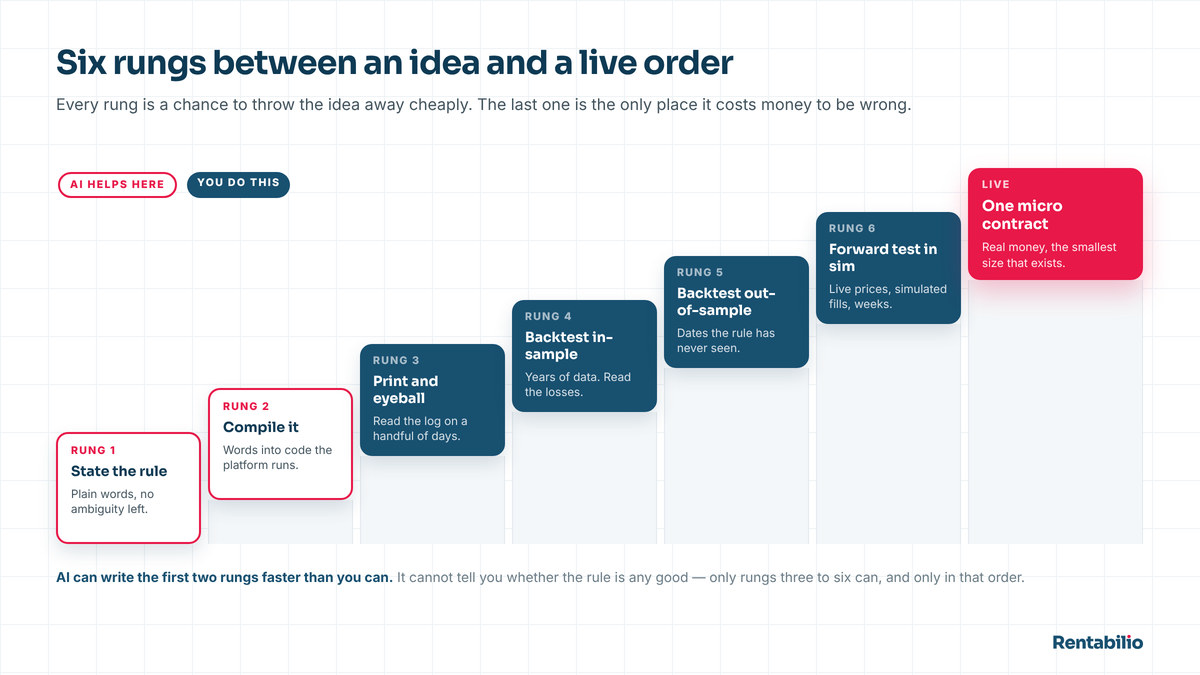
| Stage | What it proves | What it does not prove |
|---|---|---|
| It compiles | The syntax is legal | That it does what you meant |
| Values print correctly on a chart | The logic fires where you intended | That firing there is profitable |
| Backtest over the full history | How it behaved on data you can inspect | That you did not shape the rule to fit that data |
| Backtest on a period you held back | It survives data it was not built around | That the future resembles either period |
| Simulation or market replay | Order handling, fills and timing behave | Real slippage in a fast market |
| One micro contract, live | Everything, cheaply | Nothing. This is the actual test |
The danger with an AI-assisted workflow is speed. You can now generate and test twenty variations in an afternoon, which is exactly how people fit a strategy to noise without noticing. Read overfitting and curve fitting before you start, and what a backtest is if the word is new. Also budget for slippage and commissions, which turn plenty of beautiful backtests into flat live results.
Rentabilio is rule-based, specified by people, and its backtest covers more than seven years day by day. You can reproduce it in your own NinjaTrader 8 instead of building from scratch.
Job three: let it read your trade journal
This is the most underused application and probably the most valuable, because it works on the part of trading that is actually broken: you.
Export your trades: date, time, direction, size, entry, exit, result, and if you keep one, a note about why. Strip anything identifying. Then ask flat, uncomfortable questions. What is my win rate by time of day. Do I size up after a loss. What is my average hold time on winners versus losers. Which day of the week costs me money. How many of my losses came from trades outside my own written rules.
You will get answers you did not want. Almost everybody discovers they hold losers longer than winners and trade larger after a bad session, both textbook and both invisible from the inside. The model is not being clever here; it is doing arithmetic you have been avoiding. The broader picture is in why most traders lose, and the specific ways automation gets sabotaged by its owner are in automation mistakes.
Job four: checklists, rulebooks and summaries
Funded account rules are where this pays for itself immediately. A prop firm's rulebook runs dozens of pages and roughly six lines in it can end your account: the daily loss limit, how the trailing drawdown is calculated, whether it trails on closed or unrealized profit, the news restrictions, the flat-by time, and the consistency rule on payouts.
Paste the rulebook and ask for exactly those. Then (and this is the part people skip) go verify each one against the original text. A summary is a starting index, not a source of truth. If you get it wrong, the firm's system will not care where your summary came from. More detail in funded account rules explained and funded capital.
The line: research assistant versus order entry
Here is the distinction that matters more than any other on this page, and it is not about capability. It is about accountability.
Everything above is asynchronous. You ask, you read, you check, you decide, and if the answer was wrong you find out before money moves. Wiring a model directly to order entry (feed it prices, let it emit trades) removes every one of those steps. The output arrives when the market is moving, nobody checks it, and the failure mode is not a bad trade but an unbounded one.
Three things make it worse than it sounds. The same prompt can produce different answers, so the behavior is not reproducible. There is no backtest, because replaying a nondeterministic system over history teaches you nothing. And you cannot debug it: the answer to "why did it do that" is a probability distribution.
Anything touching your order entry should be boring, deterministic, and readable by a human at 3 AM.
None of that argues against automation. It argues that the automation should be a fixed set of rules, which is what algorithmic trading has always meant, and what automated trading products actually are underneath the marketing.
Combining AI research with a rules-based system
The workflow that holds up in practice puts each tool where it belongs. The AI reads, explains and audits. A specified system executes. You supervise.
That is how Rentabilio is built. It is not AI, and we say so on every page that mentions it. It is a rule-based system for NinjaTrader 8 that trades US index futures in one window a day, at 8:30 AM ET, when American economic data hits and the pre-open starts moving. It places the stop and the target in the market at the instant it enters, with the target at 2× the risk. It never holds a position overnight.
The backtest covers more than seven years, 88 months day by day, on a $50,000 funded account: $274,406 gross and roughly $260,700 net after commissions of about 5%, near $1 per micro contract. In the simulation that averages about $35,500 a year, near $2,900 a month. It won 46.2% of 4,557 trades, with an average winner of $354 against an average loser of $193, a profit factor of 1.58 and a max drawdown of $4,379. It loses more often than it wins, and the ratio is what pays.
Those are simulated figures, published in that much detail for one reason: you can regenerate them yourself in the Strategy Analyzer. Use an AI tool to help you understand every line of that report if you like. That is exactly the right job for it.
Hypothetical performance. The figures above come from a backtest, not from a live account. Simulated results are prepared with the benefit of hindsight, carry no financial risk, and cannot fully account for real execution, slippage or liquidity. Past performance, real or simulated, does not guarantee future results.
A week of this, concretely
What the workflow looks like when nothing dramatic is happening.
- Sunday. Feed last week's trades in. Ask three uncomfortable questions. Write down one thing to stop doing.
- During the week. The system trades its window. You do not touch it. Anything you do not understand in the platform gets asked, then verified.
- When you want to change something. You do not change it live. You state the change in English, have the code written, backtest it, and compare it against the unchanged version over the same period.
- Before a new prop firm account. Summarize the rulebook, verify the six lines that can end the account against the original text, then start.
Notice how little of that is exciting, and how none of it involves asking a machine what the market will do. The honest survey of what AI can and cannot do in markets is in AI trading, and the tool-by-tool view is in best trading software.
Frequently asked questions
Can I use ChatGPT to trade automatically?
You can wire one to a broker API, and people have. You should not. The output is nondeterministic, so the same inputs can produce different trades, which means it cannot be backtested and cannot be debugged after a bad day. Use it to write and review a deterministic strategy, then let that strategy do the executing.
Can AI write a NinjaTrader strategy that works?
It can write NinjaScript that compiles and does what you described, which is a real time-saver. Whether it makes money is entirely down to whether your rule had an edge. The model contributed typing, not insight. Expect it to occasionally invent API methods or slip into NinjaTrader 7 syntax, and treat compiling and backtesting as mandatory rather than optional.
Is it safe to paste my trading data into an AI tool?
Trade logs stripped of account numbers and personal details are low risk and genuinely useful to analyze. Never paste license keys, broker credentials, API keys or account numbers, because there is no benefit and the downside is unbounded. Check whether the provider trains on submitted content, and use a business tier or a local model if the data is sensitive.
Why does it give me a price when it cannot see the market?
Because it is built to produce plausible text, not to report facts. A fabricated price and a correct definition come out of the same process, in the same calm tone, with no internal marker separating them. The model has no mechanism for saying "I do not know," which is precisely why every number it gives you has to be checked somewhere else.
Does Rentabilio use AI?
No. Rentabilio is rule-based: conditions written by people, executed by NinjaTrader 8 at 8:30 AM ET, with the stop and target placed in the market at entry. Nothing in it fits itself to data or changes its own behavior over time. That is the reason its backtest can be reproduced by anyone with the platform and the same historical data, which is a property no black box can offer.
What is the fastest way to start using AI in my trading this week?
Export your last three months of trades, strip the identifying details, and ask for your win rate by time of day, your average hold time on winners versus losers, and how many losses came from trades outside your own rules. It takes ten minutes and it tends to be the most useful thing anyone learns about their trading all year. Everything else on this list can wait.