It is 8:29 AM ET on a Tuesday. Nobody is in the room. There is a cold cup of coffee on a desk in a spare bedroom and the person who owns the account is in the shower.
At 8:30:00 a US economic release hits the wire and the pre-open starts moving. Seconds later a program on that computer sends three orders in the same instant: an entry, a stop below it, a target twice as far away. Forty minutes later the position closes and the platform writes a line in a log file. The owner made no decisions this morning. He made them months ago, in writing.
That is automated trading with the marketing stripped off. Not a robot with opinions. A plan that executes itself.
Automation does not improve a trading plan. It closes the gap between the plan and what gets done. If the plan has an edge, that gap was costing you money. If it doesn't, automation just loses the money faster and more politely.
What automated trading is, and what it is not
Automated trading means writing rules a computer can execute, connecting the program to a broker, and letting it send real orders without asking you first. The rules are boring on purpose: when these conditions are true, buy this size, stop here, target there, close when either is touched.
Three things it is not. Each one costs people money every year.
- Not prediction. It applies a fixed response to a repeatable situation and accepts being wrong often. The published Rentabilio backtest is wrong on 53.8% of its trades and still finishes ahead, because the wins are bigger.
- Not passive income. Nobody pays you for owning software. You pick the capital, size the position, read the account rules and decide whether to keep running it while it is underwater.
- Not hands-off forever. Somebody turns the machine on, keeps the platform updated and reads the logs. Very little work. Not zero.
What it removes is the human at the moment of execution. On the evidence, that is where most retail money dies. Not in the analysis. In the doing.
The chain inside the machine: data, decision, order, log
Every automated system, from a hedge fund's to the one in that spare bedroom, is the same four-link chain.
- Data in. The platform takes the exchange stream and hands each tick to the program. Delayed or dirty data poisons everything downstream.
- Decision. The code checks its conditions. Almost always the answer is "not now," and doing nothing is correct. A system that must trade daily was built to look busy.
- Order out. Orders go to the broker's API. A serious system sends the protective orders in the same breath as the entry, so the worst case is defined before anything happens.
- Log. Every decision, fill, rejection and error is written down: the link that tells you whether the system still behaves like its own history.
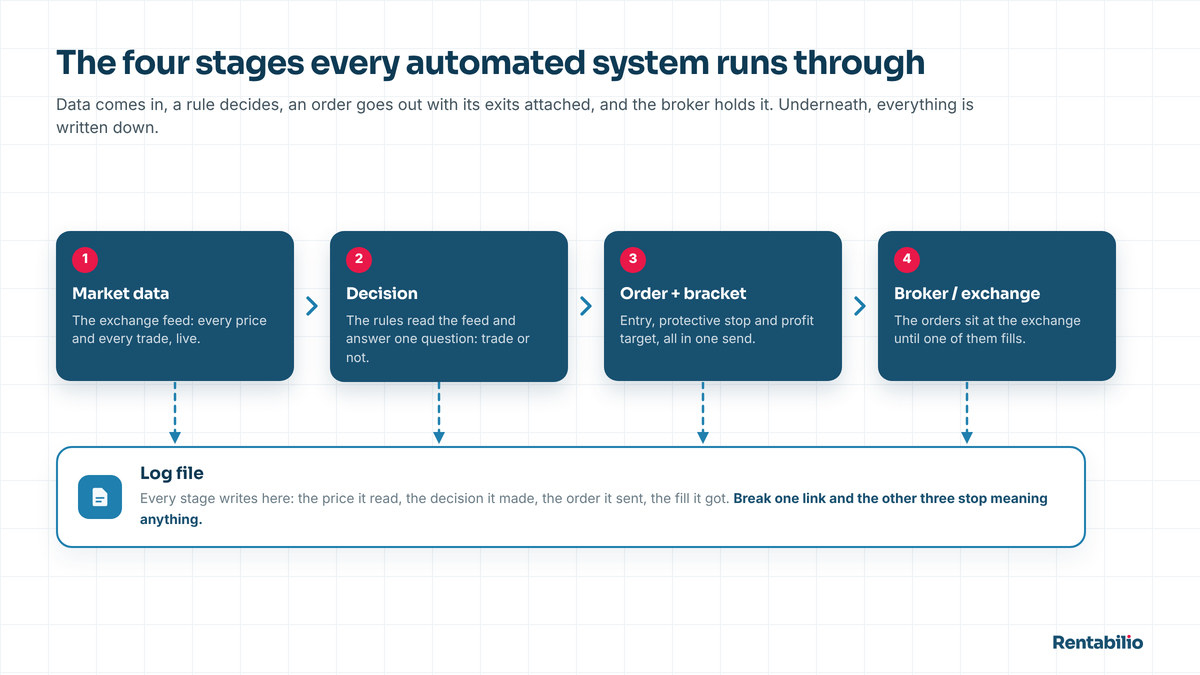
The chain contains no opinion, no hesitation, no revenge. You can see it applied to one specific system on how it works.
From an institutional desk to a spare bedroom
Rule-based trading is not new. Floor traders ran mechanical systems on paper in the 1970s. What was expensive then was not the idea. It was the plumbing: a data feed, a line to the exchange, and programmers.
Three things collapsed those costs. Exchanges went fully electronic, so an order from a laptop reaches the matching engine the way an institution's does. Retail platforms shipped full programming environments. And in 2019 the CME launched micro contracts, cutting trade size by a factor of ten and making a $10,000 account a legitimate place to run a system.
What did not collapse is the hard part. Institutions still have better fills, cheaper commissions and full-time researchers. The gap narrowed on plumbing and stayed exactly as wide on thinking, the subject of algorithmic trading.
The tools got cheap. The discipline never went on sale.
The four things sold under one name
"Automated trading" sells four products with almost nothing in common. Most of the money lost in this field comes from buying one while believing you bought another.
| Family | How it makes money | What you must trust | How it fails |
|---|---|---|---|
| Rule-based system on a retail platform | A small edge repeated over hundreds of trades | That the rules weren't fitted to the past | The edge was never there |
| Grid and martingale bots | Selling oscillations, adding size against the move | That the market keeps oscillating | One trend empties the account in a day |
| Signals and copy trading | Somebody else's decisions, mirrored | A person you cannot audit | They change rules or quit, and you learn late |
| Machine-learning black boxes | A model fitted to historical patterns | A process nobody can explain | It degrades silently, and no one knows why |
None is fraudulent by definition. What separates them is how much you can inspect before paying: a rule-based system runs in your own platform over dates you choose, and a black box does not. More in best trading bots and best trading systems.
By hand or by system: what actually changes
Automation is not about speed. A system trading one window a day competes with nobody on microseconds. What changes is consistency, and consistency has a dollar value.
| By hand | By system | |
|---|---|---|
| Rules on a bad day | Negotiable, and you will negotiate | Identical to a good day |
| Stop placement | Often mental, often moved | Live at the broker from the first instant |
| Missed setups | Whenever you're away or unsure | None, if the machine is on |
| Testable in advance? | No. You cannot backtest a person | Yes, day by day, over years |
| What limits the result | Your nerves | The quality of the rules |
| How it goes wrong | You break your own plan | You override it, or the plan was bad |
That last row is the honest one. Automation moves the failure point from your discipline to your judgment about what to run.
Everything you need to run one
The inventory is short, and every line is checkable before you commit.
None of it requires a technical background. The install and first simulated session are in get started; the index futures specifics are in futures trading bot.
What it costs, line by line
Most pages about automated trading talk about returns and go quiet about costs. Costs are the part you can be certain of, so they come first.
| Line item | Typical cost | Avoidable? |
|---|---|---|
| Platform: analysis and backtesting | $0, no time limit | Already free |
| Platform: live automation | Lease, one-time license, or higher per-contract rates | No, but you choose the shape |
| Real-time CME data, non-professional | Roughly $10 to $15 a month | No; sometimes bundled |
| The strategy | Once. See pricing | Free systems exist, usually for a reason |
| VPS, optional | A few dollars a month | Yes, if you leave a PC running |
| Commissions | ≈$1 per micro contract, every trade | No. Budget 5% of gross |
| Funded evaluation | ≈$100 for 50k, ≈$250 for 100k, ≈$400 for 250k | Only on your own capital |
| Slippage | Small per trade, real in aggregate | No; reduced by liquid contracts |
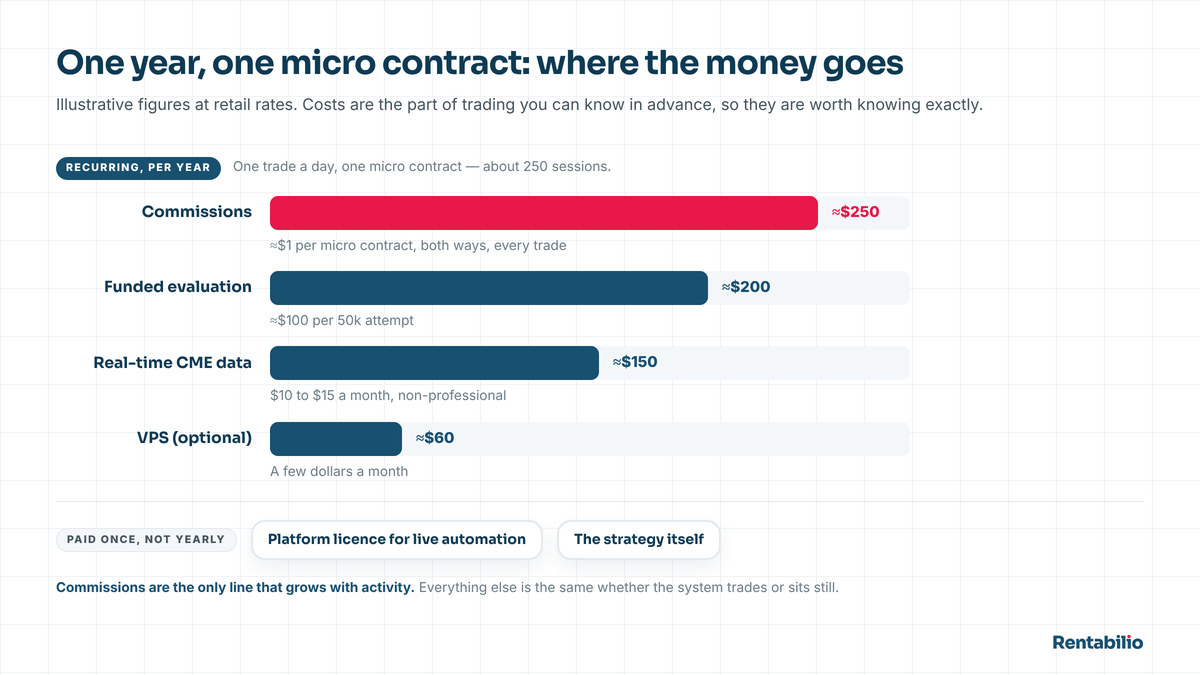
Two lines get forgotten. Commissions shave roughly 5% off gross at micro volumes. And an evaluation fee is not a one-time entry ticket: accounts get consumed and re-bought.
Two routes to the capital, worked out in dollars
There are two places the money can come from, and the choice changes almost everything.
Route one, your own account. You post margin and keep every dollar. The catch is sizing: you fund the drawdown, not the margin. The backtest shows a maximum drawdown of $4,379 on one micro contract, and the worst drawdown in any record is only the worst one so far. Two to three times that on top of margin puts a one-contract account near $10,000 to $15,000. That is money that can go to zero without changing how you live.
Route two, a funded account. A prop firm sets an evaluation on a simulated account. Hit the target without breaking the drawdown or daily loss rules and they fund you, then you split profits. A 50k evaluation costs roughly $100, which caps a single loss at $100 rather than at whatever is in your account. In exchange you accept their rulebook, and a trailing drawdown that can end a profitable account. We support Apex Trader Funding, Lucid Trading, My Funded Futures and Tradeify, meaning the system is built to run inside their rules. You buy the evaluation yourself and pay the firm directly. We do not sell, fund or provide accounts, and no account is included with the software. See funded capital.
The worked example, dollar by dollar
The last seven months of the published backtest: 50k funded account, one micro contract. Simulated figures.
- Gross: $43,322 over seven months.
- Commissions at ≈$1 per micro take about 5%, leaving roughly $41,000 net.
- Accounts consumed: about seven, ended by trailing drawdowns. At ≈$100 each, ≈$700, about 1.7% of the net.
- Data and VPS at ≈$27 a month: ≈$190.
- Before the split: roughly $40,100. Firms keep a share and cap early payouts. Apply their terms to that number, never to the gross.
Now the part the pitch skips. That stretch ran about $5,900 a month against a full-backtest average of ≈$2,900 net per month, or ≈$35,500 a year. Roughly double the norm. A good run, not a typical one.
Hypothetical performance. Every figure above comes from a backtest, a simulation over historical data. No real money was at risk, and simulated results are prepared with hindsight and cannot fully reflect execution, slippage or liquidity. Past performance, real or simulated, does not guarantee future results.
The complete report: 4,557 trades, every losing month, the deepest drawdown, and how to run it yourself.
How you measure a system, and the disease that fakes it
Total profit is the least informative number in a track record: the destination, nothing about the road.
| Metric | What it tells you | In the Rentabilio backtest |
|---|---|---|
| Number of trades | Whether the sample means anything | 4,557 over 88 months |
| Win rate | How often it is right. Alone, nearly meaningless | 46.2%; it loses more often than it wins |
| Average win / loss | Whether the wins pay for the losses | $354 / $193, a ratio of 1.84 |
| Profit factor | Dollars won per dollar lost; under 1.0 it loses | 1.58 |
| Maximum drawdown | The deepest hole you had to sit through | $4,379 on one contract |
| Test period | Whether it saw more than one market | 7+ years, day by day |
| Net after costs | The only profit number that is real | ≈$260,700, from $274,406 gross |
A 46.2% win rate reads as a defect until you do the math. With the target at twice the risk, breakeven sits near a 33% hit rate. Right 46% of the time with wins 1.84 times the size of losses is what a durable edge looks like: unimpressive per trade, positive in aggregate.
Now the disease. A backtest is the most useful tool in this field and the easiest to poison. Curve fitting is a developer nudging parameters until the historical equity curve looks beautiful; the result is a system tuned to noise that no longer exists. Invisible in the report, obvious in live trading three weeks later. Defenses: a long test period, few parameters, and out-of-sample data the developer never saw. See overfitting and curve fitting.
Everything that can break
- The edge decays. Markets change, and a system that worked for years can stop working without announcing it. You detect it by comparing live behavior to the historical distribution, not by feel.
- Power or internet dies. The program stops watching, but stops and targets already resting at the broker stay alive. This is why real orders beat mental ones.
- The plumbing fails quietly. A platform update breaks the build; a lapsed data feed means no ticks and no trades. You may not notice for days if you never read the logs.
- Slippage in fast markets. Fills a few ticks worse than the backtest assumed. Small each time. Not small over 4,557 trades.
- A funded account rule you never read. The commonest way a working system produces a dead account: a trailing drawdown closes it while the strategy is doing exactly what it should.
- You. Switching it off after three red days, widening a target because the market feels lively, doubling size to make back a bad week. Each one turns the thing you tested into something with no track record.
Only one of those is a software problem. The rest are human. What a normal bad stretch looks like is on the risk page.
Legal and taxes in the United States
Automating orders in your own account is legal in the US. What is regulated is trading other people's money or advising for compensation, which requires registration with the CFTC and NFA membership. Buying software and running it on your own account is neither. A prop firm evaluation is different again: you trade the firm's simulated capital under a contract, not client funds. The rule that binds everyone: nobody may promise you returns, and any figure from a simulation must be labeled as one.
On taxes, US futures generally fall under Section 1256 and its 60/40 rule: 60% of the gain or loss treated as long-term, 40% short-term, whatever the holding period. Open positions are marked to market at year end, a non-issue for a system that holds nothing overnight. Funded account payouts are treated differently (often ordinary income on a 1099) because a firm paid you rather than you trading your own contracts. Background in futures taxes under Section 1256. None of this is tax advice.
Warning signs, wrong fits, and real timelines
The warning signs when somebody sells you a system
Account screenshots instead of a reproducible report. Monthly percentage promises, which no fund on earth delivers reliably. A win rate above 80%, which almost always means tiny targets and an enormous hidden stop. No maximum drawdown published. Testimonials with stock photos. Countdown timers. And the clearest tell: you cannot run the thing yourself, before paying, over dates you choose. Checklist in trading bot scams and red flags.
Who this is not for
Anyone trading money they need. Anyone who wants excitement: a good system is deliberately dull, and boredom makes people meddle. Anyone who cannot watch an account fall for six weeks without touching it. Anyone expecting to replace an income in the first quarter.
How long it really takes
About a week to install the platform and get comfortable. One or two more to reproduce a backtest and sit through simulated sessions. Then an evaluation, which takes as long as it takes: sometimes two weeks, sometimes three failed attempts across two months. Then the part nobody markets: a quarter or more of live trading before you have enough trades to say anything statistical about your own results.
What Rentabilio is, and the road to a first trade
Rentabilio is the system sold on this site: a strategy for NinjaTrader 8 trading US index futures on micro contracts. It does four things.
- It trades one window a day, at 8:30 AM ET, when US economic data is released and the pre-open starts moving. The rest of the day it is asleep. A system awake 24 hours mostly finds 24 hours of commissions.
- It reads order flow before entering. Session bias, real volume, where institutional pressure shows up. If the read is not clean it does not trade that day.
- It places stop and target in the same instant as the entry, target at 2× the risk. The worst case is known before anything happens.
- It never holds overnight. Target or stop, the trade ends and the day is over.
The published backtest covers 88 months day by day on a $50,000 funded account, one micro contract: $274,406 gross, ≈$260,700 net, 4,557 trades, a 46.2% win rate, profit factor 1.58, maximum drawdown $4,379. Simulated results over historical data; past performance does not guarantee future results.
From curiosity to a first trade, five steps, none irreversible:
- Read the backtest and the risk page: drawdowns first, profits second.
- Install NinjaTrader 8, connect data, reproduce the report over dates you pick.
- Run it in simulation through several live 8:30 AM ET sessions.
- Choose a capital route: your own account sized off the drawdown, or a ≈$100 evaluation.
- Start at one contract, keep the logs, and change nothing for at least a quarter.
If something is unclear, the contact form opens a support ticket with a reference. It is the only door in. No email address, no chat.
Frequently asked questions
Is automated trading legal in the United States?
Yes. Running a program that places orders in your own account is legal, and it already accounts for much of the volume on US futures exchanges. Registration with the CFTC and NFA applies to people managing other people's money, not to a self-directed trader using software. Your results are still reportable to the IRS, and futures fall under Section 1256.
How much money do I need to start automated trading?
On the funded route, roughly $100 for a 50k evaluation, plus the platform, the strategy and about $12 a month for data. Budget three or four evaluations across your first months, because accounts get consumed and re-bought. On your own capital the figure is closer to $10,000 to $15,000 for one micro contract, because you fund the drawdown, not the margin.
Does my computer have to be on all day?
Only during the window the system trades. A strategy that works one session a day needs the platform running through that session and nothing more. A small virtual private server keeps everything up around the clock for a few dollars a month.
Can an automated system lose money?
Yes, and it will, regularly. The published Rentabilio backtest loses on 53.8% of its trades and went through a maximum drawdown of $4,379 on one contract. A system makes money by winning bigger than it loses across many trades, not by avoiding losses.
How do I know whether the system I bought is still working?
You compare it against its own history rather than against your hopes. Four or five losses in a row are normal at a sub-50% win rate and prove nothing. What matters is whether the win rate, the average win and the drawdown stay inside the range the backtest showed.