Roughly seven funded accounts were consumed in the strongest seven-month stretch of the Rentabilio backtest. Seven accounts, about $700 in evaluation fees, against $43,322 gross. Those are backtest figures: a simulation over historical data, with no real money at risk.
That sentence is the whole guide in miniature, and it is the part of prop firm trading nobody advertises. Accounts are not trophies you win once and keep. They are consumable and metered, and the sensible way to think about them is as raw material with a running cost.
Here is how the arrangement works, in plain language, including the uncomfortable parts.
You are not being hired, and nobody hands you an account. You buy the evaluation yourself, directly from the firm, and what you are buying is a bounded bet: your maximum loss is the fee you paid, their maximum loss is capped by rules that close the account the instant it gets close. Understanding that the rules exist to protect their money, not to coach you, explains almost every clause you will read.
What a modern futures prop firm actually is
The old meaning of "prop trading" was a firm hiring traders to trade its capital, on a desk, with a salary and a boss. That still exists and you cannot buy your way into it.
What the retail futures industry now calls a prop firm is something else. It is a company that sells you an evaluation: a test on a simulated account, with a profit target and a set of rules. Pass it and the firm opens a funded account in your name and signs a contract paying you a share of the profits that account generates.
The detail most often glossed over: on many programs the funded account is itself simulated, and the firm hedges or mirrors flow at its own discretion rather than routing every micro contract to the exchange. Your payouts are real money either way, paid under a contract. But you are not a broker's customer with an account of your own, and you do not have the protections that come with one. You have a commercial agreement with a private company.
How the business model works
Say it plainly, because the marketing will not. A prop firm has two revenue lines. The first, and by far the larger, is evaluation fees: people buy evaluations continuously, most of them fail, and many of those buy another. That is a subscription business with churn, dressed as a meritocracy. The second is the firm's share of profits from the minority of accounts that reach payouts.
None of that makes the model a scam. It makes it a business with an honest trade at the center: you pay a bounded fee for access to capital you do not have, they collect fees from the many and split profits with the few. What you should refuse to believe is the framing that a firm is hunting for talent and rooting for you. It sells a product with a low pass rate, and the rules are calibrated so its exposure stays small.
If a firm's rules seem designed around their risk rather than your success, that is because they are. Plan accordingly.
Evaluation phase versus funded phase
Two different documents, two different rulebooks, and people routinely read only the first.
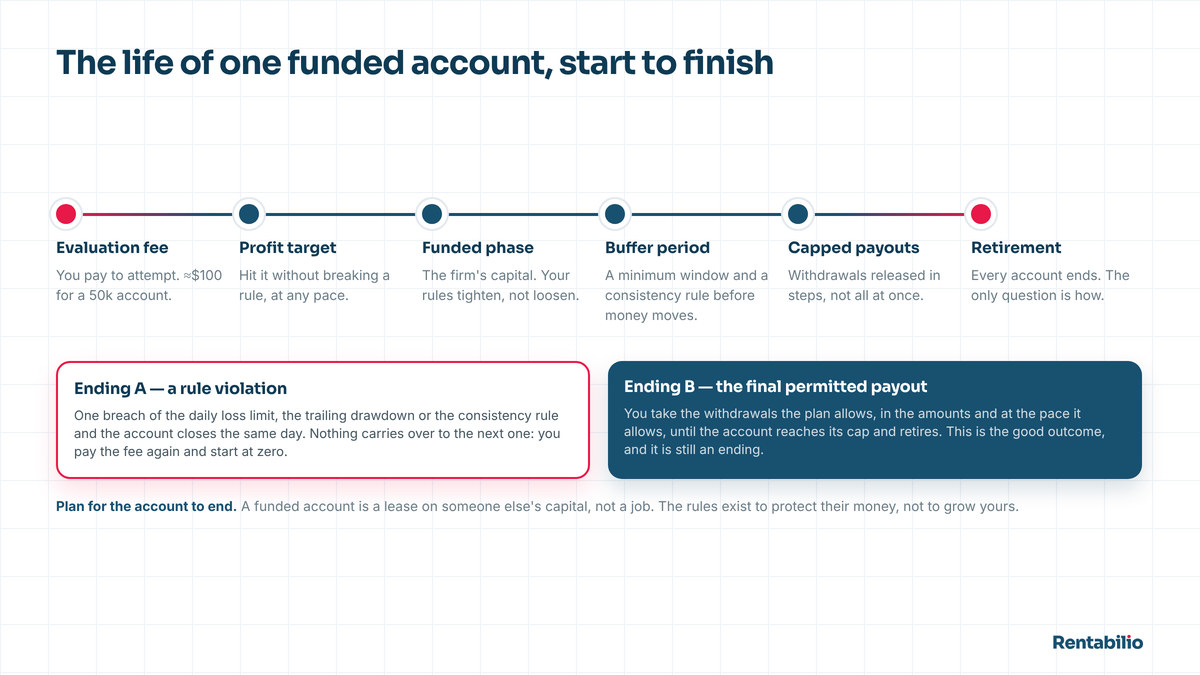
In the evaluation you pay the firm a fee and trade a simulated account until you reach a profit target without breaking a rule. As a working baseline, that fee runs roughly $100 for a 50k, around $250 for a 100k and around $400 for a 250k. Many programs now have no time limit, which settles the correct response to a slow month: keep doing the same thing.
In the funded phase you sign the trader agreement, sometimes pay an activation fee, and start accumulating profit toward a payout. Some rules relax here: trailing drawdowns often stop trailing once the account clears its starting balance. Others tighten, particularly around consistency and withdrawals. Read the funded rulebook separately, before you pass, not after.
Every rule type, explained
Most accounts do not fail on bad trading. They fail on a rule nobody read. Here is the full catalog; your account's specific numbers will differ, but the mechanics do not.
| Rule | What it measures | What it punishes | Danger level for a system |
|---|---|---|---|
| Profit target | Total gain during the evaluation | Being too slow or timid to finish | Low. A gate, not a deadline |
| Trailing drawdown | Distance below your highest point | Giving back profit you never banked | Highest. Ends most accounts |
| End-of-day drawdown | Distance below your highest closing balance | The same, measured gently | Moderate. Far more survivable |
| Daily loss limit | One session's damage in isolation | A single terrible day | Low at one contract, real at size |
| Consistency rule | Best day as a share of total profit | One outsized winner carrying everything | Moderate. Delays passing |
| Minimum trading days | Number of days with activity | Passing on a lucky streak | Low. A daily system satisfies it |
| News restrictions | Positions held across scheduled releases | Trading into a data spike | Decisive at 8:30 AM ET |
| Flat by close | Positions open at a stated deadline | Overnight exposure the firm never agreed to | Low if nothing is held overnight |
| Scaling plan | Contracts held versus account balance | Size that outruns the equity behind it | Moderate. A setup step, never skip it |
The drawdown rule, in detail
Understand this one before any other. A trailing drawdown follows your highest point upward and does not come back down. Take a $50,000 account with a $2,500 allowance. Those are illustrative figures, not your account's. Your floor starts at $47,500. You reach $51,200, so the floor trails to $48,700. You are now $2,500 from failure measured from a peak you may never see again, and two ordinary losing days can end the account while you are still up on the month.
Worse, some trailing drawdowns follow your intraday high rather than your closing balance, so an unrealized profit you never banked permanently raises the floor. An end-of-day drawdown only moves on closed daily balances, which is dramatically gentler.
Find this line first. It matters more than the price, the split and the marketing combined. Each rule is covered individually in every funded account rule explained.
The rule that catches automated systems
News restrictions. Some firms prohibit holding positions across high-impact scheduled releases, usually within a few minutes either side. Read that against the fact that 8:30 AM ET is precisely when the major US economic data lands, and that Rentabilio trades that window deliberately, as described in how it works. If a firm restricts trading around scheduled data, that firm and that system are incompatible. Settle it before buying an evaluation, not after.
Payouts: what an account can actually pay you
Passing is the part everyone talks about. Getting money out is the part that decides what the exercise was worth, and it is governed by four numbers most people never look up.
- The split. Your share of what the account earns, commonly 80% to 100% in US futures and often 90%. The marketing hero, and the least important variable here.
- The cadence. Payouts run on a schedule, not on demand. Every fourteen days is common; some firms weekly, some monthly. There is usually a minimum withdrawal too.
- The cap per payout. The number that surprises people. On a 50k account a limit around $2,000 per payout is typical, scaling with account size.
- The number of payouts before retirement. On many plans an account does not live forever. After a set number of withdrawals it closes, permanently.
Do the arithmetic on those middle two. A $2,000 cap on a fourteen-day cadence puts an effective ceiling near $4,000 a month on what one 50k account can deliver, no matter what it earned. Add buffers and safety nets on top. Most firms require a cushion above the starting balance before any withdrawal, and again afterward, so the first payout lands later than you expect.
The last bullet reframes everything: an account has a finite total yield, knowable in advance. Cap per payout, times payouts permitted, minus the split. That figure is the honest answer to "what is this account worth." Not "unlimited." Full breakdown in how you actually get paid.
Why the result comes from a bankroll, not one account
Once you accept that accounts are metered and consumable, the operating model falls out on its own. You do not nurse one immortal account. You run several, cycle them as they die or retire, and treat evaluation fees as a running cost of production.
The backtest makes this concrete. Its strongest seven-month stretch produced $43,322 gross and roughly $41,000 net. That works out at about $5,900 a month, roughly double the historical average of ≈$2,900 net per month across 88 months. About seven funded accounts were consumed along the way.
| The bankroll arithmetic, strongest 7-month stretch of the backtest | Figure |
|---|---|
| Gross profit | $43,322 |
| Net after commissions (≈5%) | ≈$41,000 |
| Average per month | ≈$5,900 |
| Ceiling on one 50k account (≈$2,000 cap, biweekly) | ≈$4,000 per month |
| Funded accounts consumed | ≈7 |
| Evaluation cost per 50k account | ≈$100 |
| Total evaluation fees over the stretch | ≈$700 |
| Fees as a share of net result | ≈1.7% |
Two conclusions come out of that table. First, one 50k account physically could not have paid out what the system earned in that stretch: the cap bites exactly in your good months. Second, the fees for replacing seven accounts amounted to under two percent of the net result. Accounts are the raw material, not the achievement.
This also explains why the published maximum drawdown of $4,379 is not a flaw. It is larger than the allowance on a typical 50k evaluation, so accounts get consumed by design rather than by accident. Sizing across the bankroll stays the same: 50k at one contract, 100k up to two, 250k up to five. Those are ceilings, not instructions.
Hypothetical performance. Every performance figure above comes from a backtest, a simulation over historical data with no real money at risk. Simulated results are prepared with hindsight and cannot fully reflect real execution, slippage or liquidity. Past performance, real or simulated, does not guarantee future results.
Account size, contract count, payout caps and the published backtest figures in one place, with the ceilings applied.
Is automation allowed? Is copy trading?
Two separate questions, and both need a written answer before you spend anything.
Automated trading. Many US futures firms permit it, some restrict it to certain account types, and some prohibit it outright. Policies also change. A forum post from last year is not evidence. Find the sentence in the firm's own current rules, and if it is ambiguous, ask and keep the reply.
Copy trading. Running one system across several accounts is how the bankroll model actually scales, and firms differ on whether they allow it, how many accounts may be linked, and whether copied accounts must be the same size. Ask before you buy the second account.
Two more for the same sitting: the news policy, for the reason above, and the maximum accounts per person, a hard ceiling on your entire operation. The mechanics are in passing an evaluation with a bot, and the wider case in automated trading.
How prop firm payouts are taxed
This is general information, not tax advice, and the details depend on the firm and on your situation. Take it to a CPA.
The common structure in US futures prop trading: because you were never trading your own capital, payouts typically arrive as independent contractor income reported on a 1099, not as trading gains. That generally means ordinary income, possibly with self-employment tax. It is a materially different outcome from the Section 1256 treatment that applies to futures in your own account, where 60% of the gain is taxed at long-term rates and 40% at short-term rates regardless of holding period.
People are frequently surprised, having read about the 60/40 rule and assumed it covers everything futures-related. It does not automatically extend to money a prop firm pays you under a contract. Firms structure agreements differently, so check what yours issues, set money aside, and have the conversation before your first payout rather than the following April. Background in futures trading taxes and Section 1256.
How to choose a firm
Sort on survival, not on discounts. In order of weight: drawdown type, automation policy, copy trading policy, payout record and speed, accounts per person, rule stability. Then, last, the profit split and the price.
We publish no per-firm terms here, for a simple reason: they would be wrong within a month. Evaluation prices move with promotions that run more or less permanently, drawdown structures get revised, payout caps and cadences shift, automation policies tighten and loosen. Check every number on the firm's own page on the day you buy. A table here would only give someone a confident reason to be wrong.
These are the firms our customers most commonly use with this system. You open the account and pay the evaluation fee yourself, directly with the firm: we do not sell, fund or provide accounts, and no account is included with the software. The notes below describe general reputation, not current terms.
Other established names in the same market (Topstep and Take Profit Trader among them) fall outside the list above, and we have no view on them either way. Apply the same variables yourself; the method is in how to choose a prop firm.
What a realistic start looks like
- Pick the firm before the account size. Drawdown type and automation policy first. Price breaks ties.
- Buy one 50k evaluation. One account and one contract: the exact configuration the published backtest runs, so it is the only one whose behavior you have already studied.
- Read the funded rulebook while still in evaluation. No surprises on the day you pass.
- Expect the first payout in weeks, not days. Minimum trading days, buffers and cadence all sit in the way.
- Add accounts only after one full cycle. Learn how the firm behaves at payout time before scaling.
- Budget evaluation fees as a recurring line, not a purchase. This is the biggest mental adjustment.
And treat a failed account as a line item, not a wound. Chasing a lost evaluation with a bigger one is the most expensive habit in this business, and it appears in the mistakes that ruin a good system for a reason. To talk through how a specific firm's constraints fit this system, open a ticket.
Frequently asked questions
Is prop firm trading legitimate, or is it a scam?
The model is legitimate and the trade is honest enough: a bounded fee for access to capital, with rules that cap the firm's exposure. What is not honest is the marketing, which implies passing is the hard part and payouts follow naturally. Most participants lose their evaluation fees, and the firms know the distribution precisely. Treat it as a bounded bet with a known cost and the arrangement is reasonable; treat it as a job application and you will be disappointed.
How much money do I need to start?
Roughly $100 for a 50k evaluation as a typical baseline, plus enough to replace it a few times, because accounts get consumed. The realistic entry cost is not one fee but several, since a system with any drawdown at all will eventually breach a floor. Budget for a handful of evaluations rather than a single purchase, and treat software as a separate line. The platform is free for backtesting and simulation.
Can I run an automated system on a funded account?
Often yes, but it depends entirely on the firm and it is not safe to assume. Some allow full automation, some restrict it to particular account types, and some prohibit it. The same applies to copying one system's trades across several accounts, which is what the bankroll model requires. Find both policies in writing on the firm's current rules page before paying for anything, and check the news restriction policy in the same sitting.
What happens to my profit if I break a rule?
You lose it. A violation closes the account immediately, the balance is forfeited, and the evaluation fee is gone. There is no probation, no appeal and no smaller account as a consolation. That is exactly why drawdown type matters more than the profit split, and why the rules deserve an hour of reading before the first trade rather than after the first problem.
How are prop firm payouts taxed in the United States?
Typically as independent contractor income reported on a 1099, because you were never trading your own capital, rather than under the Section 1256 treatment that applies to futures in your own account. That usually means ordinary income and possibly self-employment tax. It varies by firm and by how the agreement is structured, so confirm what yours issues and talk to a CPA before your first payout, not the following spring.
Is a bigger account better?
Not usually, at least not first. Larger accounts have larger payout caps and permit more contracts (up to two on a 100k, up to five on a 250k), but they cost more to evaluate, roughly $250 and $400, and they lose more in a drawdown. Most people get further by adding accounts at a size they already understand. Run both versions in the calculator before deciding.