Somewhere on the internet right now there is a chart showing 847 winning trades and zero losers. It is real. Nobody edited it. And the account it came from was wiped out three weeks later.
Understanding how both of those things can be true is most of what you need to know about trading robots: what they are, what is inside one, and why the word has the reputation it does.
What a trading robot actually is
A trading robot is a program that places orders according to fixed rules. It watches a price feed, waits for a condition it was told to look for, sends an order to the broker, and closes the position when a rule says to close it. That is the whole definition. The industry uses "robot," "bot," "expert advisor," "automated system" and "algo" for the same thing.
There is no thinking in it. A robot does not have a view on the economy, does not read the news and does not get a feeling about the market. It has conditions and it has actions, and it will execute them on a Tuesday exactly as it did on the Tuesday before, whether the last five trades won or lost. If you want the same idea from a different angle, start with what a trading bot actually is.
That indifference is the entire product. Human beings are the weak link in trading, and not for lack of information: brokers offering leveraged CFDs in Europe and the UK are required to publish the share of retail accounts that lose money, and that number lands between roughly 70% and 85% almost everywhere it gets measured. Those people knew their rules. They abandoned them at the worst possible moment, which is what people do.
A robot is an amplifier, not an author. It makes a good set of rules get followed perfectly, and it makes a bad set of rules lose money perfectly. Everything hinges on which one you bought, and that is a question you answer by checking, not by hoping.
What is inside one
Open up any serious trading robot and you find the same seven parts. They are worth knowing by name, because almost every failure you will read about is one of these parts being missing or done badly.
| Part | What it does | How it fails |
|---|---|---|
| Data feed | Supplies the prices and volume the rules read | Bad or delayed data makes correct logic act on fiction |
| Entry logic | Decides that now is a moment to buy or sell | Tuned so tightly to history that it only worked on history |
| Filter | Decides when not to trade at all | Missing entirely, so the robot trades every day, good or not |
| Position sizing | Sets how many contracts go on the trade | Sizes up after losses; this is where accounts die |
| Exit logic | The stop and the target, ideally live orders at the exchange | Held in software as an intention, not sent to the market |
| Order layer | Talks to the broker, handles fills, rejects, disconnects | Assumes a perfect fill at the price on the chart |
| Log | Records every decision so it can be audited later | Absent, so nobody can ever say why it did what it did |
Notice how little of that is clever. The exciting part, the entry logic, is one row out of seven, and it is not the row that decides whether you keep your money. The filter and the exit logic do that. A robot with a mediocre entry, a strict filter and a hard stop will outlive a robot with a brilliant entry and no stop, every single time.
A robot is not a signal, and not a copy trade
Three things get sold as automation and only one of them is. The differences decide who is actually holding the risk.
| Trading robot | Signal service | Copy trading | |
|---|---|---|---|
| Who places the order | The software, on your account | You, by hand, after an alert | A platform, mirroring a stranger |
| Rules you can inspect | Documented and testable | Rarely disclosed | Almost never disclosed |
| Can it be backtested | Yes, by you | No. Posted entries, edited exits | No, only a track record you cannot audit |
| Your job | Turn the platform on | Be at the screen all session | Choose a person and hope they stay the same |
| Main failure | The rules stop working | Your execution eats the edge | They change size or style and tell nobody |
A signal service moves the hardest part of the job (pressing the button under pressure) back onto you, and that is the part most people are bad at. Copy trading solves execution but hands you a black box with a human inside it, which is a different problem and not a smaller one. The trade-offs are worked through in copy trading vs bots.
Where the bad reputation came from
The word "robot" got its reputation in retail forex, roughly 2008 to 2016, and it earned it.
The platform of the era let anyone write an "expert advisor" and sell it as a file for a few hundred dollars. There was no exchange, no central order book and no standard price: your broker quoted the price, filled the trade, and profited when you lost. On top of that sat a marketplace of vendors selling EAs on the strength of an equity curve, and a hosted-statistics service (Myfxbook, mostly) whose verified-looking widget of somebody's green account became the industry's standard proof of everything. The tool was fine. What vendors did with a screenshot of it was not.
The economics were brutal in one direction. If you sell a robot that doubles an account in a month, you sell thousands of copies before anyone can show it does not last. If it blows up, you rename it and sell it again. Nobody ever came back and audited anything, because there was nothing to audit: the record lived on the vendor's own dashboard.
The forex robot era did not fail because the software was bad. It failed because nothing could be verified, and the people selling knew it.
Two things are different now, and both matter. Regulated futures give you a central exchange with one public price, so a backtest and a live fill are talking about the same market. And a strategy written for a standard platform can be handed over and re-run by the buyer, which turns a claim into something you can check yourself. That is the whole argument for the modern version of this, and it is laid out in automated trading.
Martingale, and the arithmetic nobody shows you
If you take one thing from this page, take this one. Martingale is the single most dangerous idea sold to retail traders, and it is the engine underneath most of those flawless track records.
The rule is simple: after a loss, double the size of the next trade. Win, and you recover everything plus the original target. It works, over and over, until the run of losses is long enough. Then it takes the whole account in one sequence. Watch what a $100 starting risk does.
| Loss number in the run | Risked on this trade | Total lost so far | Win rate still on display |
|---|---|---|---|
| 1 | $100 | $100 | Above 95% |
| 3 | $400 | $700 | Above 95% |
| 5 | $1,600 | $3,100 | Above 95% |
| 7 | $6,400 | $12,700 | Above 95% |
| 9 | $25,600 | $51,100 | Above 95% |
| 10 | $51,200 | $102,300 | Account gone |
Ten losses in a row on a coin flip is about a 1-in-1,000 event. That sounds safe until you notice that the robot takes hundreds of trades a year, so it is not asking whether the run happens. It is asking when. Meanwhile every trade before the last one closed green, so the published record shows a 95%-plus win rate right up to the moment the account is at zero. The curve is beautiful and then it is vertical.
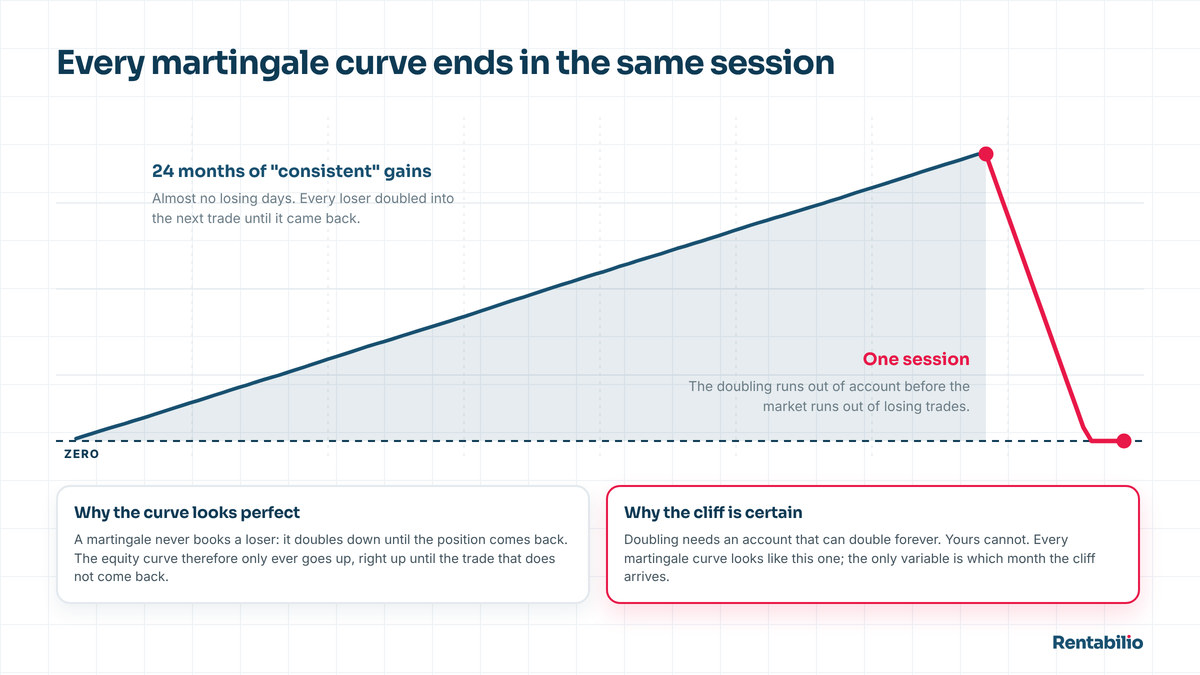
Grid bots, averaging-down bots and most "no stop loss" systems are the same idea wearing different clothes. The tell is always the same: a robot that adds to a losing position has no defined worst case. If a seller cannot tell you the maximum dollar loss on a single sequence, the answer is your whole account. That question belongs on the short list you take to every vendor, which is what best trading bots is about.
What "no losing trades" really means
A robot advertising zero losing trades is not lying. It is telling you where the losses are hidden, and there are only three places they can be.
- In open positions. Closed trades are all winners because losers are never closed. They sit open, underwater, waiting to "come back." The equity curve is fine and the account is not.
- In the next sequence. The martingale above. Every trade wins until the one that ends the story.
- In a tiny target with a huge stop. Take $10, risk $500. You will win nineteen times out of twenty and still lose money over a hundred trades. This is the most common version and the least obvious.
Which is why the win rate is close to useless on its own. What matters is the win rate next to the average winner and the average loser. Risk one unit to make two, and you are profitable while being wrong two times out of three. The arithmetic is in risk-reward and win rate.
Rentabilio wins 46.2% of its trades in backtest and is profitable because the winners are bigger. The whole report is published, drawdowns included, along with the steps to run it yourself.
Why regulated futures is a saner place to automate
The market you automate in changes the odds more than the robot does.
US index futures trade on a central exchange. There is one price, visible to everyone, with the full order book behind it. Contracts are standardized, so a backtest and a live trade are describing the same instrument. Sessions have defined hours, which means a robot can be built to work in a specific window instead of grinding around the clock. The exchange is a counterparty to both sides, so your broker does not profit from your loss. And micro contracts let you take real positions in small size. The mechanics are in futures and micro contracts.
None of that makes a bad robot good. It makes a good robot checkable, which is the only advantage worth paying for. The contrast with the 24-hour, fragmented, exchange-risk world most bots live in is drawn out in crypto bots vs futures bots, and the practical side of the market itself is in how to trade futures.
What a robot needs from you
"Fully automated" does not mean nobody is involved. Here is the actual list, and it is short.
That fourth card does more damage than all the others combined. A robot you keep adjusting is not a robot. It is you, trading, with extra steps.
What results from a solid robot look like
Here is a real shape, so you have something to measure claims against. Rentabilio runs on NinjaTrader 8 and trades US index futures in a single window each day, at 8:30 AM ET, when US economic data lands and the pre-open starts moving. Entry, stop and target go into the market in the same instant, with the target at twice the risk, and nothing is ever held overnight. The mechanism is in how it works.
In backtest over more than seven years (88 months, day by day) on a $50,000 funded account, it produced $274,406 gross across 4,557 trades, roughly $260,700 net after commissions of about 5% at approximately $1 per micro contract. That averages near $35,500 a year, about $2,900 a month.
Now the parts a marketing page would bury. It won 46.2% of its trades: it is wrong more often than it is right. It is profitable because the average winner is $354 against an average loser of $193, a ratio of 1.84 and a profit factor of 1.58. The deepest drawdown across the whole test was $4,379. Read that as a stretch you would have to live through, not as a statistic. A strong recent run of seven months made $43,322 gross, roughly double the historical monthly pace, and the honest way to read a run like that is as a good stretch rather than the new normal.
That is what a boring, working robot looks like from the inside: no 95% win rate, no straight line, a visible worst case, and a number you can reproduce on the performance page.
Hypothetical performance. The figures above come from a backtest, not a live account. Simulated results are prepared with the benefit of hindsight, carry no financial risk, and cannot fully account for real execution, slippage or liquidity. Past performance, real or simulated, does not guarantee future results.
The failures that are yours, not the robot's
Once a system is running, most of what goes wrong is a decision made by the person who owns it: switching it off during the drawdown it was always going to have, moving the stop because yesterday's got clipped, adding contracts after a good week and meeting the next bad week at triple size, or ignoring an account rule that kills the account while the strategy is fine. None of those is a software problem, and all of them are avoidable by writing down in advance what would make you stop. What the downside actually looks like is set out on the risk page, and the practical first steps are in get started.
Frequently asked questions
What is the difference between a trading robot and a trading bot?
Nothing. They are the same thing under different names, along with "expert advisor," "automated system" and "algo." The word choice usually says more about the market than the mechanism: "robot" and "EA" come from retail forex, "bot" from crypto, and "automated strategy" from platforms like NinjaTrader 8. What matters is not the label but whether the rules are documented, testable and equipped with a real stop.
Can a trading robot lose more than the money in my account?
With a hard stop placed at the exchange on every entry and no overnight exposure, your worst case per trade is defined before anything happens. Robots that average down, run grids or hold positions through the close have no such ceiling, and futures are leveraged, so a gap against a large open position can in principle take you past zero. This is exactly why "where does the stop live" is the first question to ask about any robot.
Do trading robots use artificial intelligence?
Most do not, and the ones that advertise it loudest usually mean a fitted statistical model rather than anything that reasons. A rule-based robot has the advantage of being inspectable: you can read what it does, test it and know why it acted. A model-driven one is opaque, so when it stops working nobody can tell you whether the market changed or the model was always memorizing noise.
How much money do I need to run a trading robot?
Less than people expect if you go the funded-account route, where a 50k evaluation typically costs around $100 and a 100k around $250. That fee is money you can lose, not a free trial, and most people fail an evaluation or two before passing one. Trading your own capital instead means covering the platform, the data feed and enough margin to hold a position without being one bad day from a margin call.
How do I know a robot is not a martingale in disguise?
Ask for the maximum number of contracts it will ever hold at once, and the maximum dollar loss on a single sequence. A robot with fixed size and a hard stop answers both instantly and in numbers. Anything that adds to losers will dodge the question or describe the behavior as "scaling," "averaging" or "recovery mode," and a near-perfect win rate on the sales page is the same warning written another way.