One Micro E-mini S&P contract, with the index near 5,900, represents about $29,500 of index exposure. Your broker will let you hold it intraday for a few hundred dollars, sometimes less. Everything that makes futures useful and everything that makes them dangerous is contained in that sentence.
This page is the mechanics: what the contract is, what the numbers on the specification sheet mean in dollars, which order types cost you money and when, and what one complete trade looks like from the first click to the closed position.
What a futures contract is, and what long and short mean
A futures contract is a standardized agreement to buy or sell something at a set price on a set future date. Standardized means the exchange (not you, not your broker) fixes the size, the price increment, the hours and the expiration. Every contract of a given symbol is identical, which is why they trade in one deep order book.
Going long means agreeing to buy: you profit if the price rises. Going short means agreeing to sell: you profit if it falls. In futures these are the same trade in opposite directions. There is no borrow, no locate, no uptick rule and no extra fee for selling first, because a contract is an agreement rather than an asset someone has to lend you.
Index futures are cash-settled. Nobody delivers an index. If you hold to expiration, the difference between your price and the final settlement price is credited or debited in dollars. In practice, day traders never get there: the position is closed the same session it was opened.
You are not buying $29,500 of stock with $500. You are posting a good-faith deposit against a contract whose full value moves against you tick by tick. The deposit caps what you had to put up. It does not cap what you can lose.
The specs that decide everything
Three numbers on the contract specification turn a chart into dollars: the tick size (the smallest price increment), the tick value (what one tick is worth per contract), and the multiplier (dollars per full index point). Learn them for the contract you trade and never estimate them from memory.
| Contract | Symbol | Tracks | Tick size | Tick value | Per index point |
|---|---|---|---|---|---|
| Micro E-mini S&P 500 | MES | S&P 500 | 0.25 points | ≈ $1.25 | $5 |
| Micro E-mini Nasdaq-100 | MNQ | Nasdaq-100 | 0.25 points | ≈ $0.50 | $2 |
| Micro E-mini Dow | MYM | Dow Jones Industrial Average | 1 point | ≈ $0.50 | $0.50 |
| Micro E-mini Russell 2000 | M2K | Russell 2000 | 0.10 points | ≈ $0.50 | $5 |
Notice that three of the four move about $0.50 a tick while their tick sizes differ, because the exchange picks an increment suited to each index level. "Forty ticks" is therefore a different amount of movement on each one. That is exactly the detail that ruins a position size worked out from memory. The CME publishes the current specifications and can change them; check there before sizing anything that matters. More background is in futures and micro contracts.
Who is on the other side
You never know who took the opposite side of your trade, and it does not matter. Between you sits the exchange's clearing house: for US index futures, CME Clearing. It becomes the counterparty to both sides, marks every account to market daily, and collects margin so neither participant can walk away from a losing position.
That plumbing is why you can trade with a stranger at 3:00 AM without a credit check. It is also why margin exists at all: the deposit is not a fee, it is the collateral that makes a stranger's promise good.
Hours, and the daily maintenance break
CME equity index futures trade nearly around the clock: from Sunday 6:00 PM ET through Friday 5:00 PM ET, with a daily halt from 5:00 PM to 6:00 PM ET when the session rolls over. Equity index products also pause briefly in the late afternoon, around 4:15 to 4:30 PM ET. Holidays follow their own schedule, and the exchange publishes the calendar.
Two practical consequences. First, "the market" reacts to overnight news while the stock market is shut, so a futures position carries the whole night. Second, not all hours are equal. Volume concentrates around the US morning, and the busiest single moment of a normal day is 8:30 AM ET, when scheduled economic data is released and the pre-open starts moving with intent. That is the window Rentabilio is built around, and the reasoning is in the 8:30 AM ET window.
Margin, and what a margin call is
Futures margin is not a loan. It is a performance bond you post to hold a position. Three numbers matter, and they are set by different people.
- Initial margin. Set by the exchange. What you must have in the account to open a position and carry it overnight. It moves with volatility, and on the micro index contracts it has typically sat in the high hundreds to a few thousand dollars per contract in recent years.
- Maintenance margin. Also exchange-set, slightly lower. The level your account equity must stay above once the position is open.
- Day-trade margin. Set by your broker, not the exchange, and often a small fraction of the initial requirement. On micros it can be as little as $50 a contract. It applies only intraday and disappears before the close.
A margin call happens when your account equity falls below the maintenance requirement. The broker asks you to deposit funds or reduce the position, and if you do neither it is entitled to liquidate for you, at whatever price the market is offering at that moment. On day-trade margin the process is faster and less polite: many brokers auto-flatten a position that breaches intraday requirements, without a phone call.
Low day-trade margin is not a discount on risk. It is permission to take more of it.
The honest way to use margin is to ignore it when sizing. Size off your stop, as laid out in day trading for beginners, and treat the margin figure only as a check that the trade fits in the account at all.
Order types, and when each one costs you
Every order type is a trade-off between certainty of execution and certainty of price. You can have one or the other, never both.
| Order | What it does | Guarantees | What it costs you |
|---|---|---|---|
| Market | Buys or sells immediately at the best available price | Execution | Price. In a fast market you can fill several ticks from where you looked |
| Limit | Executes only at your price or better | Price | Execution. If the market runs without you, you simply do not get filled |
| Stop (stop-market) | Rests until a trigger price, then becomes a market order | Execution once triggered | Price at the worst moment. Gaps and spikes fill past your stop level |
| Stop-limit | Triggers at one price, then works as a limit at another | Price | Everything, occasionally. In a gap it does not fill and the position stays open |
| Bracket / OCO | Entry plus a stop and a target; filling one cancels the other | That both exits exist from the first second | Nothing structural. This is the shape a plan should use |
The bracket is the important row. It means the stop and the target go into the market in the same instant as the entry, so the worst case is defined before anything happens rather than decided while it does. That is the risk model Rentabilio uses, with the target at twice the risk, and it is the single mechanical habit that separates a plan from an improvisation. What fills actually cost in practice is covered in slippage and commissions.
One trade, from entry to exit, in dollars
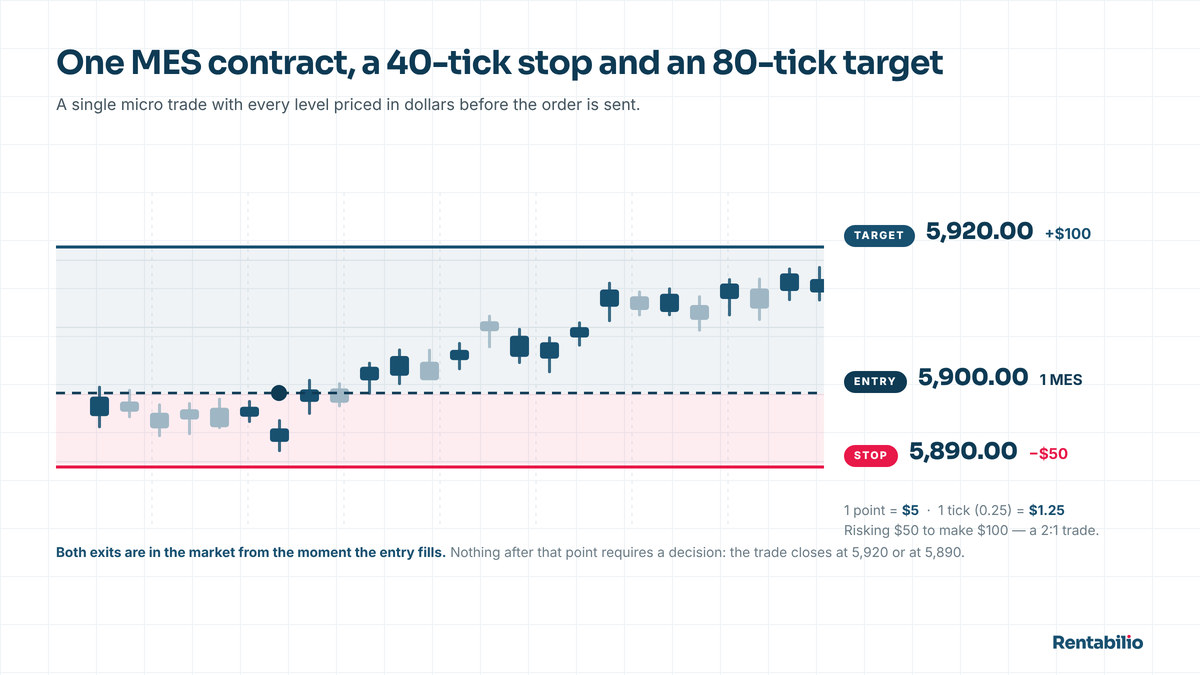
Take a long on the MES, one contract, with a bracket. The arithmetic below is a worked illustration, not a recommendation or a prediction.
- Entry. Buy 1 MES at 5,900.00.
- Stop. 5,890.00. That is 10 points, or 40 ticks, at $1.25 a tick = $50 at risk.
- Target. 5,920.00. That is 20 points, 80 ticks = $100. A 2-to-1 target.
- Outcome A, target hit. +$100, less about $1 for the round turn, so roughly +$99.
- Outcome B, stop hit. −$50, less the same dollar, so roughly −$51.
Now run ten of those at a 46% hit rate: 4.6 winners at $100 is $460, 5.4 losers at $50 is $270, so $190 gross and about $180 after commissions. That is the entire business in one line: a small positive number, repeated, with losing trades in the majority. Add slippage on the stops, because a stop becomes a market order exactly when the market is moving, and the number gets smaller still.
Contract, stop size, account size, number of trades. The calculator does the arithmetic above with your figures instead of these.
Rollover and expiration
A futures contract does not live forever. The equity index micros run on a quarterly cycle (March, June, September and December, coded H, M, U and Z) and each one expires on the third Friday of its month, cash-settled against a special opening quotation of the index that morning.
You will almost never hold to expiration. What you do instead is roll: close the expiring contract and open the same position in the next quarter. Liquidity migrates about a week before expiration, typically on the Thursday preceding that third Friday, and it moves fast. Trade the old contract a day late and you are in a thin book with wider spreads.
Two practical rules. Check which contract month your platform is actually pointed at before the session, especially during roll week. And expect a price difference between the expiring and the new contract. They are separate instruments with separate prices, so your chart may show a step that is not a market move.
Opening an account, or renting one
There are two ways to get to a live futures order, plus two things you need either way.
Own-account setup takes a few business days: the application asks about income, net worth and experience, because futures accounts carry a suitability review. The funded route skips the deposit entirely but adds a rulebook (daily loss limits, trailing drawdowns, consistency requirements) that can end a profitable account on a technicality. Read funded account rules explained before you pay for an evaluation, and prop firm trading for how the model works. Taxes are their own subject: US futures fall under Section 1256, which splits gains 60% long-term and 40% short-term regardless of holding period.
Hypothetical performance. Any Rentabilio figure referenced on this site comes from a backtest: a simulation over more than seven years of historical data, with no real money at risk. Simulated results are prepared with hindsight and cannot fully reflect real execution, slippage or liquidity. Past performance, real or simulated, does not guarantee future results.
Your first week, in simulation
Do all of this on simulated data, in NinjaTrader 8 or whatever platform you have chosen. None of it costs anything, and every one of these mistakes is cheaper made now.
- Connect and load one instrument. The front-month MES. One chart, nothing else.
- Place and cancel every order type. Market, limit, stop, stop-limit. Watch where each one fills relative to where you clicked.
- Place a bracket. Entry with a stop and a target attached. Confirm both orders are live in the orders window, then cancel the whole thing and confirm all of it is gone.
- Get stopped out on purpose. Put a stop two ticks away and watch it trigger. Note the fill price against the stop price.
- Do the tick arithmetic by hand. For each trade, write down the ticks and multiply by the tick value. Check it against the platform. Do this until they always agree.
- Sit through 8:30 AM ET. Watch the spread widen and the book thin out at a data release. Place nothing. Just watch what "fast market" means.
- Practice the roll. During roll week, switch the chart to the next contract month and notice the price difference.
Once the mechanics are boring, the question stops being how to place a trade and becomes what to place it on. That is where a tested rule set matters more than platform skill, whether you build one or run an automated system someone else has published a record for. The setup order, day by day, is in get started, and the specific case of automating this instrument is in futures trading bot.
Frequently asked questions
How much money do I need to trade futures?
There is no regulatory minimum the way there is for pattern day trading in stocks, so the real constraint is survival rather than permission. Exchange initial margin on a micro index contract has typically run from the high hundreds into the low thousands of dollars, while brokers allow far less intraday. The number that actually matters is whether the account can absorb the worst losing run your plan produces, which for most people means several thousand dollars at micro size.
What is the difference between initial margin and day-trade margin?
Initial margin is set by the exchange and is what you must have to open and hold a position, including overnight. Day-trade margin is set by your broker, applies only while the market is open, and can be a small fraction of the exchange requirement. If you are still in a position as the broker's intraday window closes, the full exchange requirement applies and many brokers will flatten you automatically rather than carry the position.
Can I lose more than I deposit?
Yes. Margin is a deposit against a contract whose full notional value moves with the market, so a gap through your stop can leave the account below zero and you owe the difference. It is uncommon on liquid micro index contracts traded intraday with a real stop order in the market, and it is exactly why mental stops are a bad idea and why position size should come from the stop rather than from the margin requirement.
When do I have to roll to the next contract?
Equity index futures expire quarterly, on the third Friday of March, June, September and December, but liquidity moves to the next contract about a week earlier, typically on the Thursday before that Friday. Roll when the volume rolls, not when the contract expires, because trading the old month after the migration means wider spreads and worse fills. Check which contract month your platform is loaded with at the start of every session during roll week.
Do I need a data subscription to trade futures?
To trade live, yes. Real-time CME index futures data carries a modest monthly fee set by the exchange and passed through by your broker, and it is separate from commissions. Simulated and delayed data are fine while you are learning the platform, but no system should be run on delayed prices. Funded-account programs often bundle data into their own platform arrangements, so check what is included before subscribing twice.
Is a bracket order always better than placing a stop afterward?
For a rules-based plan, effectively yes. A bracket puts the stop and the target in the market at the moment the entry fills, so the worst case is defined before the position starts moving and a disconnection or a distraction cannot leave you unprotected. Placing exits manually afterward means there is a window, however short, in which the position has no defined loss. That window has a way of coinciding with the fast move.